
Every morning, millions of people brew coffee — but few realize that how they make it could subtly influence their cholesterol. Whether you use a paper filter or not may change the chemical composition of your cup, and consequently, how it affects your lipid profile. The difference lies in two little-known molecules found naturally in coffee beans: cafestol and kahweol.


The Hidden Lipids in Your Coffee
Cafestol and kahweol are diterpenes, oily compounds that give coffee part of its body and aroma. However, research has shown that these same molecules can raise LDL (“bad”) cholesterol and total cholesterol in humans when consumed in sufficient amounts [1, 3, 6].
These diterpenes are lipid-soluble, meaning they pass easily into the brew if no barrier exists. When you make boiled coffee, French press, or espresso, most of those compounds remain in the final drink. But when you use a paper filter, it acts like a trap — retaining the oily droplets that carry cafestol and kahweol [1, 4].
Mechanistically, cafestol appears to reduce cholesterol breakdown in the liver by suppressing enzymes like cholesterol 7α-hydroxylase and sterol 27-hydroxylase, both of which are involved in converting cholesterol to bile acids [5]. In controlled human studies, cafestol has been shown to increase LDL and VLDL production and alter the balance of circulating lipoproteins [6].
In short, the science suggests a simple mechanism: less filtration = more diterpenes = higher cholesterol.
Boiled vs. Filtered Coffee: What Trials Reveal
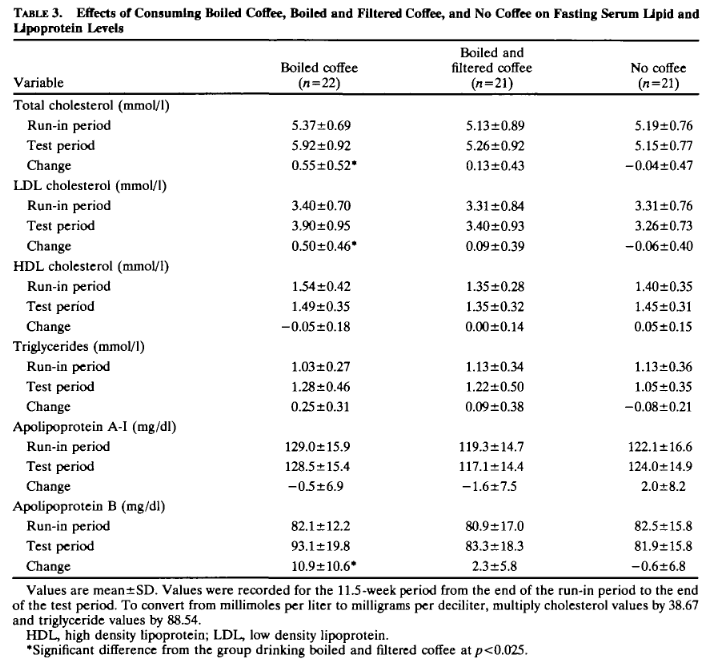
The most famous experiment on this topic dates back to 1991. In a randomized controlled trial, van Dusseldorp and colleagues compared boiled coffee, boiled coffee filtered through paper, and no coffee in 64 healthy adults over 79 days. The results were striking:
- Those drinking boiled coffee saw their total cholesterol increase by 0.42 mmol/L (≈16 mg/dL) and LDL cholesterol by 0.41 mmol/L.
- Those drinking boiled and then filtered coffee showed no significant lipid changes compared to the control group [1].
Subsequent studies and meta-analyses confirmed this effect. A 2001 meta-analysis of randomized trials found that unfiltered coffee consistently raises total and LDL cholesterol, while filtered coffee causes little or no increase [2].
Similarly, a 1990 experiment published in the New England Journal of Medicine demonstrated that consuming a lipid-rich fraction extracted from boiled coffee — essentially pure cafestol and kahweol — increased serum cholesterol dramatically within just four weeks [3].
The message is clear: the filter itself is what makes the difference.
Modern Insights: Espresso and Machine-Brewed Coffee
While the early studies focused on boiled and paper-filtered coffee, more recent research has expanded the scope to espresso and machine-brewed coffee.
In 2022, a large cross-sectional study from Norway — The Tromsø Study 2015–2016 — examined more than 21,000 adults and found that espresso consumption was associated with higher serum total cholesterol, particularly in men [7]. Boiled and French press coffee also correlated with higher cholesterol, whereas filtered coffee showed the weakest association.
Even more recently, Swedish researchers analyzed coffee brewed in workplace coffee machines and found that several commercial systems produced high concentrations of cafestol and kahweol, comparable to unfiltered coffee. The authors estimated that replacing three cups per day of such machine coffee with paper-filtered coffee could significantly reduce LDL cholesterol levels [8].
In other words, not all “filtered” coffee is truly filtered. The type of filter — metal vs. paper — and its quality matter.
Why Paper Filters Work
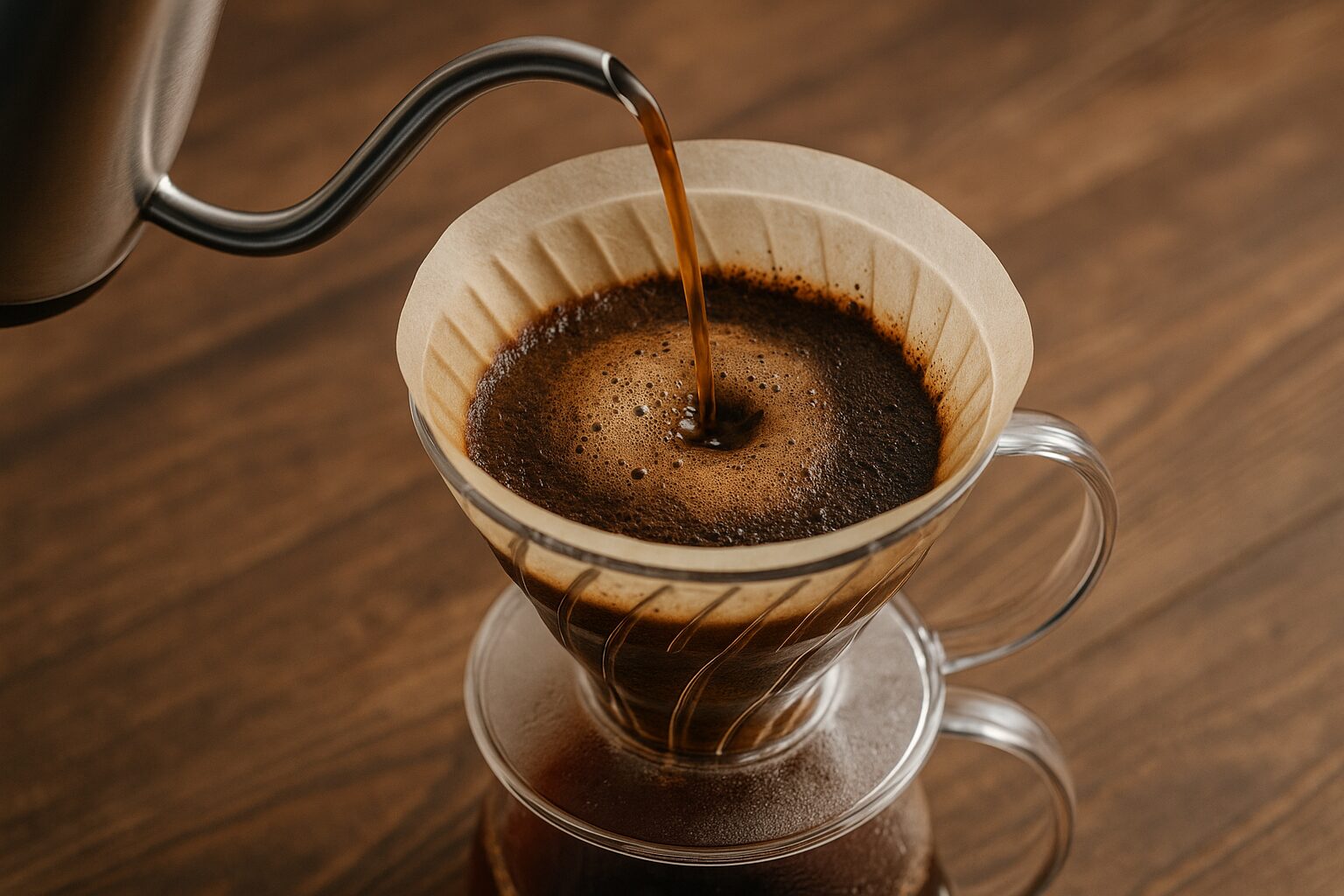
Paper filters are made of cellulose fibers that physically retain fine particles and oils. Those oils carry most of the diterpenes responsible for cholesterol increases. Laboratory analyses show that when paper filters are used, over 99% of cafestol is retained in the grounds or filter, leaving negligible amounts in the beverage [4].
That’s why coffee made with a simple drip filter or pour-over method generally has very low diterpene content and does not significantly affect lipid levels in most trials.
Espresso and French press coffee, on the other hand, contain far higher concentrations of these compounds — enough to influence cholesterol if consumed regularly and in large quantities.
How Big Is the Effect?
The cholesterol increases seen with unfiltered coffee are dose-dependent and generally modest in absolute terms. Drinking 5–6 cups of boiled or French press coffee daily for several weeks can raise total cholesterol by 10–20 mg/dL and LDL by similar amounts [1, 2, 3].
However, these changes are reversible. Studies show that serum cholesterol levels return to baseline within weeks after stopping unfiltered coffee consumption [4].
Filtered coffee drinkers, in contrast, rarely show measurable increases — suggesting that the simplest solution for cholesterol-conscious coffee lovers is simply to use a paper filter.
Beyond Cholesterol: The Bigger Picture
It’s worth remembering that coffee is a complex beverage with more than a thousand compounds. Many — such as chlorogenic acids, trigonelline, and polyphenols — are linked to lower risks of diabetes, cardiovascular disease, and all-cause mortality.
Thus, while the diterpene–cholesterol effect is real, it doesn’t mean coffee is unhealthy. The balance of evidence still supports moderate coffee consumption as compatible with good health, particularly when prepared using paper filtration.
Takeaway
If you’re concerned about cholesterol, the science is straightforward:
- Boiled, French press, and some espresso or machine coffees allow diterpenes into the cup and can raise LDL cholesterol.
- Paper-filtered coffee traps those compounds and does not significantly affect cholesterol.
- The difference is chemical, measurable, and clinically relevant for frequent coffee drinkers.
Sometimes, protecting your heart can be as simple as brewing your morning coffee through paper.
References
van Dusseldorp, M., Katan, M. B., van Vliet, T., & Demacker, P. N. M. (1991). Boiled coffee increases serum lipids, whereas filtered coffee does not. American Journal of Epidemiology, 134(6), 647–655.
Jee, S. H., He, J., Appel, L. J., Whelton, P. K., Suh, I., & Klag, M. J. (2001). Coffee consumption and serum lipids: A meta-analysis of randomized controlled clinical trials. American Journal of Epidemiology, 153(4), 353–362.
Zock, P. L., de Waard, F., Katan, M. B., & van den Berg, H. (1990). Effect of a lipid-rich fraction from boiled coffee on serum cholesterol. New England Journal of Medicine, 322(15), 997–1000.
Urgert, R., & Katan, M. B. (1997). The cholesterol-raising factor from coffee beans. Annual Review of Nutrition, 17, 305–324.
Post, S. M., de Roos, B., Vermeulen, M., Afman, L. A., Jong, M. C., & Katan, M. B. (1997). Cafestol… suppresses bile acid synthesis… Arteriosclerosis, Thrombosis, and Vascular Biology, 17(11), 3064–3070.
Urgert, R., Weusten-van der Wouw, M. P. M. E., & Katan, M. B. (1997). Effects of cafestol and kahweol from coffee grounds on serum lipids in humans. American Journal of Clinical Nutrition, 65(3), 519–524.
Svatun, Ø., Holvik, K., Madssen, T. S., & Meyer, H. E. (2022). Association between espresso coffee and serum total cholesterol: The Tromsø Study 2015–2016. Open Heart, 9(1), e001946.
Bak, A. A., & Grobbee, D. E. (1989). The effect on serum cholesterol levels of coffee brewed by filtering or boiling. New England Journal of Medicine, 321(21), 1432–1437.
de Roos, B., Katan, M. B., & Mensink, R. P. (1999). Effects of coffee diterpenes on serum lipoproteins: A 12-week randomized controlled trial. Journal of Lipid Research, 40(7), 1278–1282.
Cai, L., Ma, D., Zhang, Y., & Wang, P. (2012). The effect of coffee consumption on serum lipids: A meta-analysis of randomized controlled trials. European Journal of Clinical Nutrition, 66(8), 872–877.
About the Author

Forge Your Mind. Build Your Biology.
Join the Forge Biology newsletter — where science meets strength.
Every week, you’ll get:
-
Evidence-based insights on training, performance, and recovery
-
Real analyses of supplements that work (and the ones that don’t)
-
Deep dives into hormones, nutrition, and human optimization
No fluff. No marketing hype. Just data-driven knowledge to build a stronger body — and a sharper mind.
Subscribe now and start mastering your biology.