
Reference:
Schoenfeld, B. J., Grgic, J., Van Every, D. W., & Plotkin, D. L. (2021). Loading Recommendations for Muscle Strength, Hypertrophy, and Local Endurance: A Re-Examination of the Repetition Continuum.Sports, 9(2), 32. https://doi.org/10.3390/sports9020032
Let’s start with a confession
If you’ve been lifting for a while, you’ve probably heard it — maybe even said it yourself:
“Low reps for strength. Mid reps for size. High reps for endurance.”
It sounds logical, right?
That classic “repetition continuum” has been the backbone of gym advice for decades. Trainers taught it, books printed it, and athletes believed it.
But here’s the twist: the science has moved on.
Meet the scientists who challenged the old dogma
In 2021, a group of researchers led by Dr. Brad Schoenfeld — one of the most respected names in muscle science — decided to take another look at this long-standing belief. Alongside Jozo Grgic, Derrick Van Every, and Daniel Plotkin, they published a deep and highly technical review in the journal Sports.
Their question was simple:
Does the “repetition continuum” still hold up when tested against all the recent data?
The short answer: not really.
What the repetition continuum said (and why it made sense)
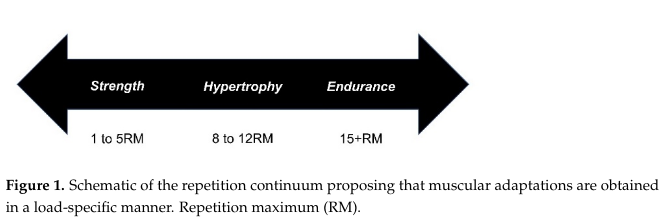
Traditionally, the rule went like this:
- 1–5 reps (80–100% 1RM) → Best for strength
- 8–12 reps (60–80% 1RM) → Best for hypertrophy
- 15+ reps (<60% 1RM) → Best for muscular endurance
It came from early work in the 1940s by Thomas DeLorme and later by Anderson, Kearney, and Stone — true pioneers of resistance training.
But as science advanced, researchers started to notice something strange: real athletes weren’t behaving like the theory predicted.
What the new evidence actually shows
After analyzing dozens of controlled studies, meta-analyses, and longitudinal data, Schoenfeld’s team came to a revolutionary conclusion:
“Muscular adaptations can be obtained, and in some cases optimized, across a wide spectrum of loading zones.”
In plain English:
You can build muscle, gain strength, and improve endurance with almost any load — as long as you train hard enough.
Heavy weights: still king for strength
Let’s make one thing clear — if your goal is to lift the heaviest possible load, you’ve got to practice heavy lifting.
That’s not old-school; that’s neurology.
Heavy training builds strength by teaching your nervous system to recruit more motor units, coordinate movement efficiently, and handle psychological intensity.
It’s like tuning your brain and your muscles to fire in perfect sync.
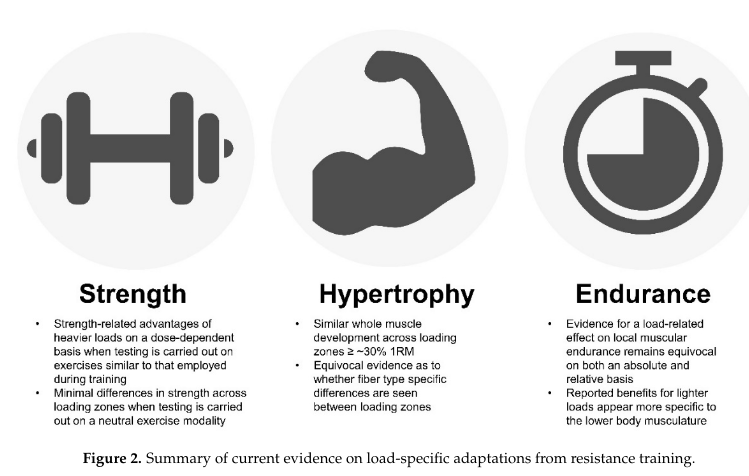
Meta-analyses show a moderate-to-large advantage for loads above 60% of 1RM when testing 1RM strength.
Still, the researchers note something interesting: even light loads (like 30–40% 1RM) can build meaningful strength — especially in beginners or during early adaptation phases.
The stronger you get, the more specific your training must become.
That’s the principle of specificity: you get good at what you practice.
Muscle growth: the equal opportunity adaptation
Now for the real bombshell.
The so-called “hypertrophy zone” — 8 to 12 reps, moderate load — is not the only way to grow muscle.
Across more than a decade of research, Schoenfeld and others have consistently found that muscle growth happens across nearly all rep ranges — from 5 reps to 30 — as long as you approach muscular failure.
Let that sink in:
You can grow with light weights and with heavy weights, if you train with intensity and sufficient volume.
So why do most people still train in the middle?
Because it’s more comfortable.
High-rep sets burn like hell. Ultra-heavy sets can crush your joints.
Moderate loads, between 60% and 80% of 1RM, hit the sweet spot — effective, efficient, and sustainable.
That’s not magic. That’s psychology and physiology working together.
Endurance: the gray area
What about muscular endurance — those 20+ rep sets that make your lungs scream?
The data here is messy.
Some studies show light loads improving endurance, especially in the legs. Others show no real difference compared to moderate training.
It depends on how “endurance” is measured (absolute vs. relative load), the exercise, and even the person’s experience level.
Bottom line: the endurance advantage of high reps isn’t as solid as we once thought — but it’s still a useful tool in the right context.
A new way to think about reps
The “repetition continuum” isn’t really wrong — it’s just too narrow.
Instead of fixed boxes (“this range = that result”), think of a fluid spectrum of adaptation:
| Training Load | Reps (approx.) | Main Adaptation | Notes |
|---|---|---|---|
| Heavy | 1–5 | Strength | Great for neural efficiency and force output |
| Moderate | 6–12 | Hypertrophy | Ideal mix of effort, recovery, and enjoyment |
| Light | 15–30+ | Hypertrophy / Endurance | Effective when trained close to failure |
Every zone works. The difference is in how you use it — not which one you choose.
The real lesson: effort is the driver
Forget obsessing over “the right number of reps.”
What matters most is effort — the proximity to muscular failure.
That’s the common thread across every successful program and every well-designed study.
If you train with focus, control, and intent, your body adapts — whether you’re curling 20-pound dumbbells for 25 reps or benching 300 for 5.
That’s the beauty of this new paradigm: freedom backed by science.
So, what should you do now?
- Mix it up. Use different rep ranges through the week or even within a workout.
- Train close to failure. Especially with light loads — don’t quit when it starts to burn.
- Respect recovery. Heavy training is powerful, but demanding.
- Pick what you enjoy. Adherence beats perfection.
When you enjoy your training, you’ll stick with it — and consistency is the real secret to transformation.
Final thoughts
The repetition continuum didn’t die — it evolved.
We now know that muscle responds to effort, volume, and consistency far more than to arbitrary rep counts.
This is what science looks like when it matures:
We stop searching for “the one right way” and start understanding how to make many ways work.
So go ahead — lift heavy, go light, chase the pump, or grind for that PR.
If you train with purpose, you’re already doing it right.
About the Author

Forge Your Mind. Build Your Biology.
Join the Forge Biology newsletter — where science meets strength.
Every week, you’ll get:
-
Evidence-based insights on training, performance, and recovery
-
Real analyses of supplements that work (and the ones that don’t)
-
Deep dives into hormones, nutrition, and human optimization
No fluff. No marketing hype. Just data-driven knowledge to build a stronger body — and a sharper mind.
Subscribe now and start mastering your biology.