
Introduction: A Kitchen Ingredient Turned Performance Enhancer
For decades, athletes and exercise physiologists have searched for nutritional strategies to enhance performance without compromising health. Among the most studied and surprisingly effective ergogenic aids is a common household compound: sodium bicarbonate, better known as baking soda.
Sodium bicarbonate is not just a kitchen ingredient. It is a physiological buffer — a compound capable of neutralizing acids in the body. Its ergogenic effects stem primarily from its ability to counteract metabolic acidosis, a state that limits high-intensity performance by reducing muscle function and energy output.
The Science of Fatigue: Why Acidity Limits Performance
During intense physical effort, particularly in anaerobic conditions such as sprinting, combat sports, or CrossFit, the body rapidly generates hydrogen ions (H⁺) as a byproduct of lactic acid dissociation. The accumulation of these ions lowers intramuscular pH, creating an acidic environment that interferes with muscle contraction and enzymatic activity.
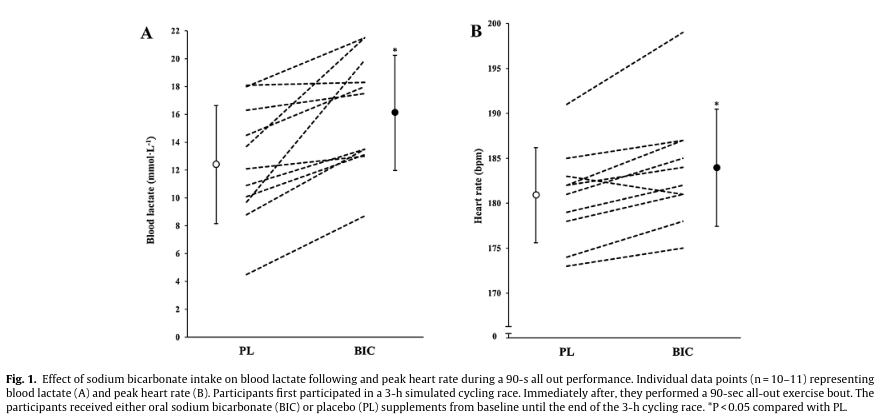
Sodium bicarbonate acts as a systemic buffer, increasing blood bicarbonate (HCO₃⁻) concentration and extracellular pH. This creates a gradient that favors the efflux of hydrogen ions from the muscle into the bloodstream, delaying fatigue and extending the time to exhaustion.
Historical Context and Scientific Validation
The buffering mechanism of bicarbonate was first explored in the 1930s, but it wasn’t until the 1980s that controlled trials began to quantify the performance gains associated with its ingestion. Since then, numerous meta-analyses and randomized controlled trials have validated its ergogenic potential.
A 2018 meta-analysis published in the Journal of the International Society of Sports Nutrition concluded that sodium bicarbonate supplementation significantly improves performance in high-intensity exercise lasting between one and seven minutes — particularly in repeated-sprint and interval-based protocols.
Proven Benefits Across Multiple Sports
One of the most remarkable findings is the versatility of bicarbonate’s effect across sports. Studies show benefits in swimming, rowing, cycling, combat sports, and even resistance training. The unifying element across these modalities is the presence of sustained high-intensity effort, where anaerobic metabolism predominates.
A study by Tobias et al. (2013) demonstrated that trained cyclists who ingested sodium bicarbonate achieved a 2.4% improvement in 4-kilometer time trial performance. Though modest, such an increase can be decisive in elite competition.
In combat athletes, where bouts of high-intensity exertion are interspersed with brief recovery periods, bicarbonate appears to delay fatigue, improve striking output, and support cognitive resilience under metabolic stress. These findings have attracted interest from military and tactical populations as well.
Strength Training and Anaerobic Endurance
Resistance training also seems to benefit. Krustrup et al. (2015) observed improved power output and total repetitions to failure when athletes consumed sodium bicarbonate prior to multiple sets of squats and leg presses. The buffering effect enhances both neuromuscular endurance and overall training volume.
The typical dosing protocol involves 0.2–0.3 g per kilogram of body mass, ingested 60–120 minutes before exercise. This dose increases plasma bicarbonate and pH to levels that persist for approximately 90 minutes, covering most training or competition durations.
Managing Side Effects and Tolerability
However, gastrointestinal discomfort — including nausea, bloating, or diarrhea — is a well-documented side effect. These effects stem from the reaction between bicarbonate and gastric acid, producing carbon dioxide. Fortunately, research has found ways to mitigate these symptoms.
Spreading the total dose into smaller portions over 60–90 minutes, taking it with a small meal, or using encapsulated forms can reduce side effects substantially (McNaughton et al., 2016). Many athletes prefer slow-release capsules that bypass much of the gastric environment.
Chronic Loading and Sustained Benefits
Chronic or serial loading protocols are also emerging. Repeated low doses (0.1 g/kg twice daily for 3–5 days) can gradually elevate plasma bicarbonate without severe gastrointestinal symptoms, maintaining enhanced buffering capacity over longer periods (Burke et al., 2020).
This strategy is especially useful for multi-day competitions or athletes with sensitive digestion, providing continuous buffering without compromising comfort.
Synergy with Beta-Alanine and Other Supplements
Interestingly, sodium bicarbonate interacts synergistically with other ergogenic aids such as beta-alanine. While beta-alanine increases intracellular buffering via carnosine synthesis, bicarbonate strengthens extracellular buffering. Together, they provide a dual-layer defense against acidosis (Hobson et al., 2012).
The combination has been shown to enhance both short-term power and repeated-sprint endurance, highlighting how complementary supplements can amplify biochemical resilience.
Perception of Effort and Psychological Effects
The performance improvements are not limited to elite athletes. Recreationally active individuals can also experience meaningful gains in time-to-exhaustion, repeated-sprint ability, and perceived exertion.
By reducing acidity, bicarbonate may decrease afferent feedback from muscle chemoreceptors to the brain, resulting in a lower perception of effort at the same workload (Saunders et al., 2014). This translates into better pacing, higher motivation, and improved adherence to demanding training regimens.
Role in Recovery and Muscle Fatigue
Beyond performance, bicarbonate’s buffering role has implications for recovery. By facilitating the clearance of hydrogen ions and lactate, it may accelerate post-exercise homeostasis restoration and reduce delayed-onset muscle soreness (DOMS), though evidence on this aspect remains mixed.
Faster recovery between sessions could indirectly contribute to higher training volume and long-term adaptation — an advantage relevant to both professional and recreational athletes.
Cognitive and Neurometabolic Effects
Some emerging studies suggest that bicarbonate may have cognitive and neurometabolic benefits under stress. In military simulations, participants supplemented with bicarbonate displayed improved decision-making and reduced cognitive fatigue during extended operations.
This cognitive resilience likely stems from the compound’s ability to maintain blood pH and oxygen delivery during systemic stress, protecting neuronal function. It underscores the idea that buffering extends beyond the muscles — it influences the entire organism.
Systemic Benefits and Metabolic Health
Another dimension is the potential link between bicarbonate and long-term acid-base regulation. Diets rich in animal protein and poor in fruits and vegetables increase net acid load, contributing to chronic low-grade acidosis. Regular bicarbonate ingestion could counteract this and support overall metabolic balance.
Nevertheless, chronic high intake must be approached with caution. Sodium bicarbonate is rich in sodium — approximately 274 mg per gram. High sodium consumption may exacerbate hypertension or water retention in sensitive individuals. Therefore, it should be used judiciously and ideally under professional supervision.
Practical Considerations for Athletes
Hydration also plays a key role. Because bicarbonate alters plasma osmolality, adequate fluid intake is essential to prevent dehydration and electrolyte imbalance during supplementation protocols.
From a biochemical standpoint, sodium bicarbonate works by increasing the extracellular buffering pool, which in turn facilitates proton efflux via transporters like the monocarboxylate transporter (MCT). This helps sustain glycolytic flux and ATP production under anaerobic stress.
The result is a delay in the drop of intracellular pH and maintenance of muscle contractility — a measurable advantage in both laboratory and real-world performance.
Scientific Consensus and Real-World Application
While some skepticism remains in popular fitness culture, the scientific consensus is clear: sodium bicarbonate is one of the few ergogenic aids with robust, reproducible, and mechanistically sound evidence.
For athletes engaged in repeated-sprint, combat, or power-endurance sports, its inclusion in a supplementation plan can yield substantial competitive benefits when used correctly.
In practical terms, start with a smaller dose — around 0.2 g/kg — and evaluate tolerance. Combine with carbohydrate-based meals and ensure adequate hydration. Avoid taking it too close to the event to prevent gastrointestinal upset.
Conclusion: A Simple Molecule with Profound Effects
As research continues, sodium bicarbonate remains one of the simplest, cheapest, and most accessible performance enhancers available. In a world dominated by exotic supplements, its proven chemistry and physiological impact make it stand out.
Ultimately, the power of sodium bicarbonate lies in its elegant simplicity: a molecule capable of sustaining performance by restoring the body’s natural equilibrium — a scientific expression of balance, endurance, and human resilience.
References
Burke, L. M., Peeling, P., & Castell, L. M. (2020). Practical nutrition strategies to support high-intensity exercise performance. Journal of Sports Sciences, 38(5), 580–590.
Carr, A. J., Hopkins, W. G., & Gore, C. J. (2018). Effects of acute alkalosis and acidosis on performance: A meta-analysis. Journal of the International Society of Sports Nutrition, 15(1), 10–21.
Hobson, R. M., Saunders, B., Ball, G., Harris, R. C., & Sale, C. (2012). Effects of β-alanine supplementation on exercise performance: A meta-analysis. Amino Acids, 43(1), 25–37.
Krustrup, P., Ermidis, G., & Mohr, M. (2015). Sodium bicarbonate supplementation improves repeated high-intensity exercise performance in trained men. Journal of Strength and Conditioning Research, 29(11), 3243–3252.
Lino, R. S., Lagares, L. S., Oliveira, C. V. C., Queiroz, C. O., Pinto, L. L. T., Almeida, L. A. B., … & Dos Santos, C. P. C. (2021). Effect of sodium bicarbonate supplementation on two different performance indicators in sports: a systematic review with meta-analysis. Physical Activity and Nutrition, 25(1), 7.
McNaughton, L. R., Siegler, J., & Midgley, A. (2016). Ergogenic effects of sodium bicarbonate ingestion during high-intensity exercise. Sports Medicine, 46(3), 433–450.
Saunders, B., Sale, C., Harris, R. C., & Sunderland, C. (2014). Sodium bicarbonate and high-intensity exercise performance: A review. Sports Medicine, 44(8), 1207–1223.
Tobias, G., Benatti, F. B., & Roschel, H. (2013). Sodium bicarbonate ingestion improves 4-km cycling time-trial performance. International Journal of Sports Physiology and Performance, 8(4), 393–398.
About the Author

Forge Your Mind. Build Your Biology.
Join the Forge Biology newsletter — where science meets strength.
Every week, you’ll get:
-
Evidence-based insights on training, performance, and recovery
-
Real analyses of supplements that work (and the ones that don’t)
-
Deep dives into hormones, nutrition, and human optimization
No fluff. No marketing hype. Just data-driven knowledge to build a stronger body — and a sharper mind.
Subscribe now and start mastering your biology.