
Definition
Calcium is the most abundant mineral in the human body, representing about 1.5–2% of total body weight. Beyond its well-known role in building bones and teeth, calcium is also crucial for muscle contraction, nerve transmission, blood clotting, and hormone signaling.
Approximately 99% of calcium is stored in the skeleton, but the remaining 1% circulates in the blood — where it performs life-sustaining functions. This delicate balance is tightly regulated by Vitamin D and parathyroid hormone, which control calcium absorption, storage, and release.
Where It’s Found
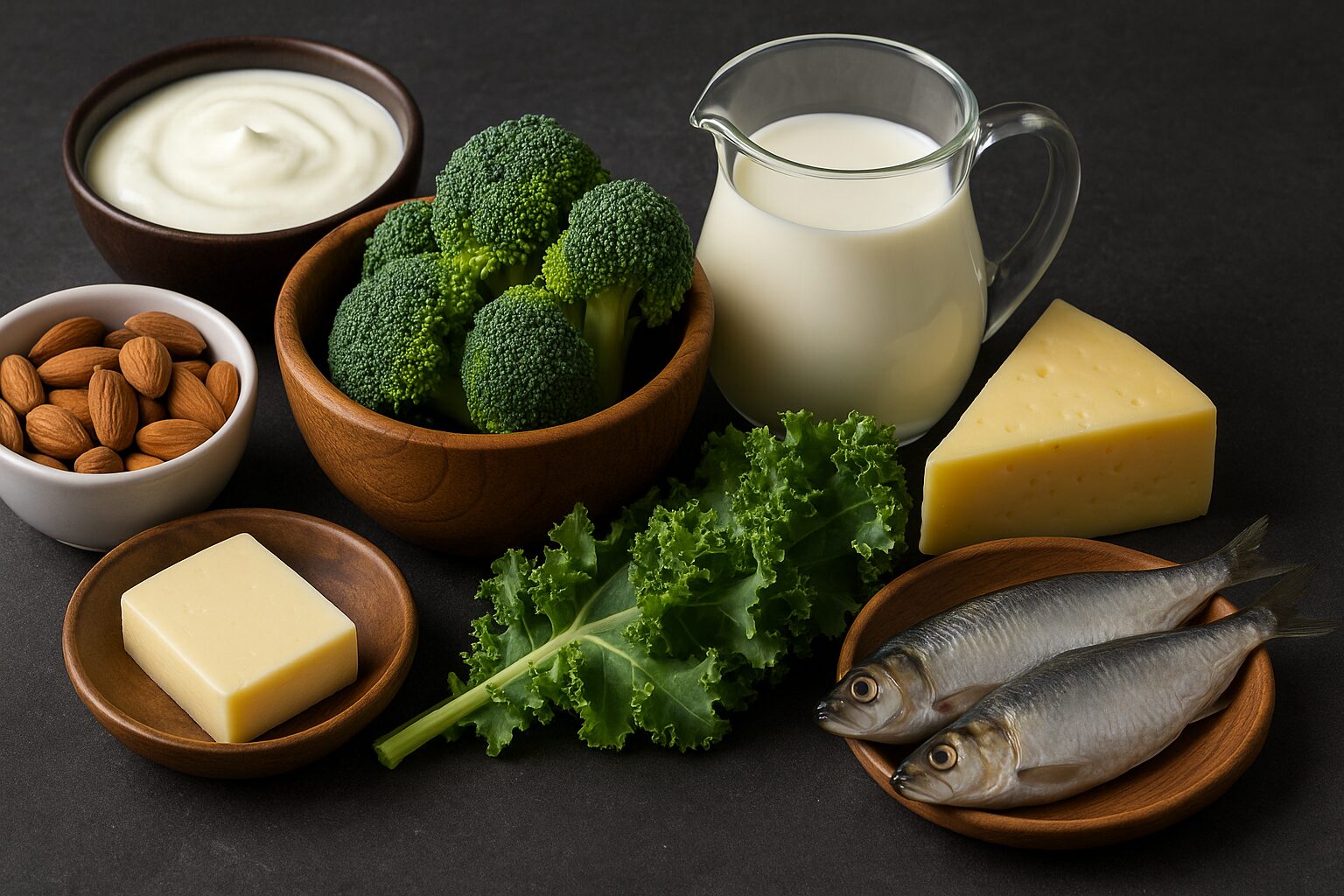
Calcium is abundant in dairy products such as milk, yogurt, and cheese, which provide the most bioavailable form. Non-dairy sources include leafy greens (kale, collard greens, broccoli), sardines with bones, almonds, chia seeds, and fortified plant-based milks.
However, not all calcium sources are absorbed equally. Oxalates and phytates — compounds found in spinach and some legumes — can bind calcium and reduce its bioavailability. Therefore, variety and timing matter as much as total intake.
Function in the Human Body
Calcium’s primary role is structural, providing the hardness of bones and teeth. Yet, its physiological functions are equally vital. It acts as a cellular messenger, enabling communication between nerves and muscles. Every heartbeat, muscle contraction, and neurotransmitter release depends on calcium ions flowing across membranes.
It also participates in blood coagulation, activating clotting factors that prevent hemorrhage. Furthermore, calcium is required for enzyme activation, insulin release, and hormonal regulation — proving it’s not just a “bone mineral,” but a cornerstone of systemic function.
Relationship with Physical Performance
For athletes and physically active individuals, calcium is indispensable. It contributes to muscle contraction strength, nerve conduction, and cardiac rhythm stability. Low calcium levels can cause muscle cramps, spasms, and even arrhythmias during intense exercise.
More importantly, long-term deficiency increases the risk of stress fractures, especially in endurance athletes or those with low energy availability. Female athletes are particularly vulnerable due to hormonal fluctuations that influence calcium metabolism.
Adequate calcium, combined with Vitamin D and K₂, enhances bone remodeling and recovery after impact-based training — ensuring durability, power, and longevity in performance.
Recommended Daily Intake (RDI)
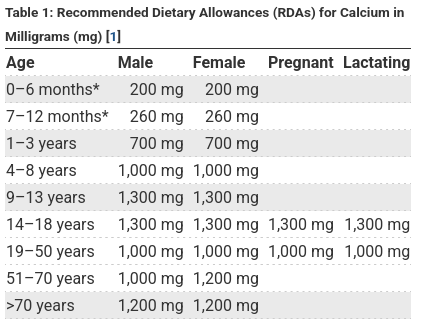
According to the National Institutes of Health (NIH):
- Men and Women (19–50 years): 1,000 mg per day
- Women (51+ years): 1,200 mg per day
- Men (71+ years): 1,200 mg per day
The upper limit is 2,500 mg per day for adults, though such high levels are rarely achieved without supplements.
How to Reach the RDI Naturally
Achieving optimal calcium levels is easy with whole foods:
- 1 cup of milk or fortified plant-based milk → ~300 mg
- 1 cup of yogurt → ~250 mg
- 1 slice (30 g) of cheese → ~200 mg
- ½ cup of cooked kale → ~90 mg
- 2 sardines (with bones) → ~130 mg
For those avoiding dairy, fortified beverages, tofu made with calcium sulfate, and chia seeds are excellent alternatives. Spreading calcium intake across the day improves absorption and minimizes digestive interference.
| Food | Milligrams (mg) per serving | Percent DV* |
|---|---|---|
| Yogurt, plain, low fat, 8 ounces | 415 | 32 |
| Orange juice, calcium fortified, 1 cup | 349 | 27 |
| Yogurt, fruit, low fat, 8 ounces | 344 | 27 |
| Mozzarella, part skim, 1.5 ounces | 333 | 26 |
| Sardines, canned in oil, with bones, 3 ounces | 325 | 25 |
| Milk, nonfat, 1 cup** | 299 | 23 |
| Soymilk, calcium fortified, 1 cup | 299 | 23 |
| Milk, whole (3.25% milk fat), 1 cup** | 276 | 21 |
| Tofu, firm, made with calcium sulfate, ½ cup*** | 253 | 19 |
| Salmon, pink, canned, solids with bones, 3 ounces | 181 | 14 |
| Cottage cheese, 1% milk fat, 1 cup | 138 | 11 |
| Tofu, soft, made with calcium sulfate, ½ cup*** | 138 | 11 |
| Soybeans, cooked, ½ cup | 131 | 10 |
| Breakfast cereals, fortified with 10% of the DV for calcium, 1 serving | 130 | 10 |
| Spinach, boiled, drained, ½ cup | 123 | 9 |
| Frozen yogurt, vanilla, soft serve, ½ cup | 103 | 8 |
| Turnip greens, fresh, boiled, ½ cup | 99 | 8 |
| Kale, fresh, cooked, 1 cup | 94 | 7 |
| Chia seeds, 1 tablespoon | 76 | 6 |
| Chinese cabbage (bok choi), raw, shredded, 1 cup | 74 | 6 |
| Beans, pinto, canned, drained, ½ cup | 54 | 4 |
| Tortilla, corn, one, 6” diameter | 46 | 4 |
| Sour cream, reduced fat, 2 tablespoons | 31 | 2 |
| Bread, whole wheat, 1 slice | 30 | 2 |
| Kale, raw, chopped, 1 cup | 24 | 2 |
| Broccoli, raw, ½ cup | 21 | 2 |
| Apple, golden delicious, with skin, 1 medium | 10 | 0 |
Final Considerations
Calcium is the foundation of physical resilience — the mineral that supports strength, coordination, and balance at every level. Its effects go beyond bones: it powers the contraction of every muscle fiber and the firing of every neuron.
Neglecting calcium means compromising the very structure and communication system of the human body. When paired with Vitamin D and K₂, it ensures that strength isn’t just built — it’s sustained.
In the architecture of performance, calcium is the frame that holds it all together.
About the Author

Forge Your Mind. Build Your Biology.
Join the Forge Biology newsletter — where science meets strength.
Every week, you’ll get:
-
Evidence-based insights on training, performance, and recovery
-
Real analyses of supplements that work (and the ones that don’t)
-
Deep dives into hormones, nutrition, and human optimization
No fluff. No marketing hype. Just data-driven knowledge to build a stronger body — and a sharper mind.
Subscribe now and start mastering your biology.