
Reference and Context
The article “Effects of Plyometric Training on Physical Performance: An Umbrella Review” was published in 2023 in the open-access journal Sports Medicine – Open (Springer Nature).
It represents one of the most comprehensive reviews ever conducted on plyometric training, a method that uses rapid stretching and shortening of muscles — the stretch-shortening cycle (SSC) — to develop power and explosiveness.
The research was carried out by an international team of exercise scientists from Brazil, Australia, and Belgium:
- Rafael L. Kons – Department of Physical Education, Federal University of Bahia (Brazil)
- Lucas B. R. Orssatto and Gabriel S. Trajano – Queensland University of Technology (Australia)
- Jonathan Ache-Dias – Catarinense Federal Institute (Brazil)
- Kevin De Pauw and Romain Meeusen – Vrije Universiteit Brussel (Belgium)
- Juliano Dal Pupo and Daniele Detanico – Federal University of Santa Catarina (Brazil)
Together, they conducted an umbrella review, a high-level form of systematic review that compiles and critically analyzes findings from multiple meta-analyses on a single topic. This type of work sits at the top of the scientific evidence hierarchy.
Why the Study Was Conducted
Plyometric training is widely used by athletes and coaches to increase power, speed, and jump performance. Yet, despite its popularity, the literature had become scattered and sometimes contradictory.
Some studies reported major gains in performance, while others found minimal or inconsistent effects — especially when comparing athletes of different sports, training levels, or age groups.
The authors aimed to answer a few essential questions:
- What are the real, measurable effects of plyometric training on physical performance?
- Do these effects vary across populations — such as athletes vs. non-athletes, men vs. women, and young vs. older adults?
- And most importantly, how strong and reliable is the scientific evidence behind these claims?
Methods: How the Evidence Was Gathered
The authors followed the internationally recognized PRISMA guidelines (Preferred Reporting Items for Systematic Reviews and Meta-Analyses) and registered their protocol in the PROSPERO database under ID CRD42020217918.
Between February and May 2022, they searched six major scientific databases:
PubMed/MEDLINE, Scopus, SPORTDiscus, Web of Science, Cochrane Library, and SciELO.
From an initial pool of 612 publications, the researchers carefully screened and filtered results, eventually including 29 meta-analyses that met strict inclusion criteria. Together, these studies represented over 10,000 participants, covering a broad spectrum of sports and fitness levels — from youth and elite athletes to recreationally active adults and seniors.
To assess the credibility of each meta-analysis, the authors applied the AMSTAR 2 checklist, a validated tool for evaluating methodological quality in systematic reviews.
Results: What the Evidence Shows
Overall Quality
- 22 of the 29 meta-analyses (about 76%) were rated moderate in quality.
- Six were of low quality, and only one reached high quality.
- The most common methodological issue: 24 out of 29 meta-analyses lacked a control group, relying instead on “pre-to-post” comparisons within the same subjects — which weakens causal conclusions.
Despite these limitations, the collective data showed clear and consistent improvements in several performance indicators.
Performance Outcomes
1. Jump Performance
Plyometric training produced moderate to large improvements in vertical jump height across nearly all populations.
Sports involving frequent jumping — such as volleyball, basketball, and handball — showed the most pronounced effects.
2. Sprint and Speed
Across studies, plyometric programs led to small-to-moderate improvements in sprint performance, particularly over distances of 10–30 meters.
The effects were strongest among trained athletes, who already possess developed neuromuscular systems that respond efficiently to explosive movements.
3. Strength and Power
Lower-body muscular strength and power improved significantly, especially when training was performed over several weeks.
In older adults, plyometric programs enhanced lower-limb strength, balance, and functional mobility — key elements for reducing the risk of falls.
4. Change of Direction (COD) Ability
Moderate improvements were observed in agility and directional change tasks, suggesting that plyometric drills enhance not only raw power but also neuromuscular coordination and reaction efficiency.
5. Endurance and Balance
Although not the main target of plyometric training, some studies found small positive effects on endurance and dynamic balance, particularly in sports requiring repeated sprinting or intermittent effort.
Discussion: How to Interpret These Results
The authors emphasize that plyometric training is effective for improving several dimensions of physical fitness.
Its benefits stem from both neural and mechanical adaptations:
- Enhanced muscle-tendon stiffness, allowing more efficient storage and release of elastic energy.
- Greater neuromuscular activation and coordination.
- Improved rate of force development, crucial for explosive actions.
- Increased reflex efficiency during the stretch-shortening cycle.
In essence, the muscles learn to act like high-performance springs — stronger, faster, and more economical.
However, the study also urges caution.
Because most meta-analyses lacked control groups, some of the improvements might partly reflect general training effects, rather than the specific impact of plyometric exercises.
Therefore, while the evidence is encouraging, it should not yet be considered definitive (Level 1).
Practical Implications
For Coaches and Strength Professionals
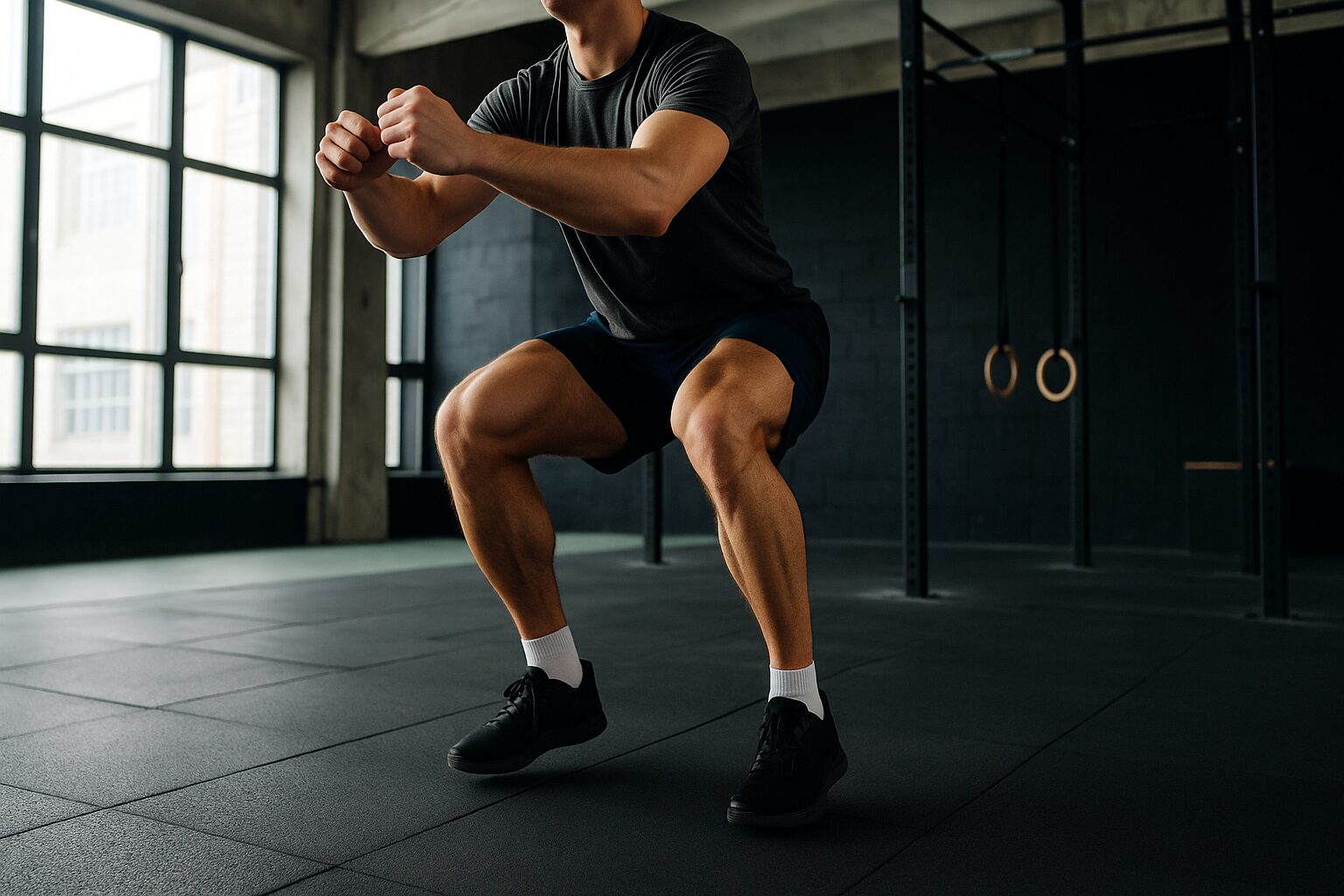
- Incorporating plyometric exercises (e.g., squat jumps, countermovement jumps, bounding, and drop jumps) can meaningfully enhance power, sprinting ability, and jumping performance.
- Programs should be periodized and scaled according to training level — avoiding excessive impact, especially for beginners.
- Combining traditional resistance training with plyometrics yields complementary benefits.
For Youth Training
- Plyometric programs are safe and effective for children and adolescents when properly supervised.
- They not only improve performance but may also stimulate healthy musculoskeletal development.
For Older Adults
- Low-impact or assisted plyometric exercises can improve balance, coordination, and functional independence.
- Evidence suggests they help mitigate age-related loss of power (sarcopenia) and reduce fall risk.
For Researchers
- Future studies should prioritize randomized controlled trials with well-defined protocols and participant descriptions.
- There is a need for more data on female athletes, older adults, and long-term adaptations.
Conclusions
- Plyometric training works. It improves speed, power, jump height, and functional performance across diverse populations.
- Evidence quality is moderate. Most studies lack proper control groups, limiting the ability to draw firm causal conclusions.
- Future research should aim higher. Randomized controlled trials are needed to strengthen the scientific foundation of plyometric training principles.
- Despite limitations, the current evidence supports the inclusion of plyometric drills in training programs for both performance enhancement and health improvement.
Final Thoughts
This umbrella review by Kons et al. (2023) stands as the most comprehensive synthesis to date on the effects of plyometric training.
Its findings confirm what many coaches have observed in practice: well-designed plyometric programs can transform physical performance.
Yet, it also reminds us of something crucial — evidence-based training demands rigor.
To fully understand how, why, and for whom plyometric training works best, science must continue refining its methods, ensuring that enthusiasm is matched with precision.
Reference:
Kons, R. L., Orssatto, L. B. R., Ache-Dias, J., De Pauw, K., Meeusen, R., Trajano, G. S., Dal Pupo, J., & Detanico, D. (2023). Effects of Plyometric Training on Physical Performance: An Umbrella Review. Sports Medicine – Open, 9(4). https://doi.org/10.1186/s40798-022-00550-8
About the Author

Forge Your Mind. Build Your Biology.
Join the Forge Biology newsletter — where science meets strength.
Every week, you’ll get:
-
Evidence-based insights on training, performance, and recovery
-
Real analyses of supplements that work (and the ones that don’t)
-
Deep dives into hormones, nutrition, and human optimization
No fluff. No marketing hype. Just data-driven knowledge to build a stronger body — and a sharper mind.
Subscribe now and start mastering your biology.