
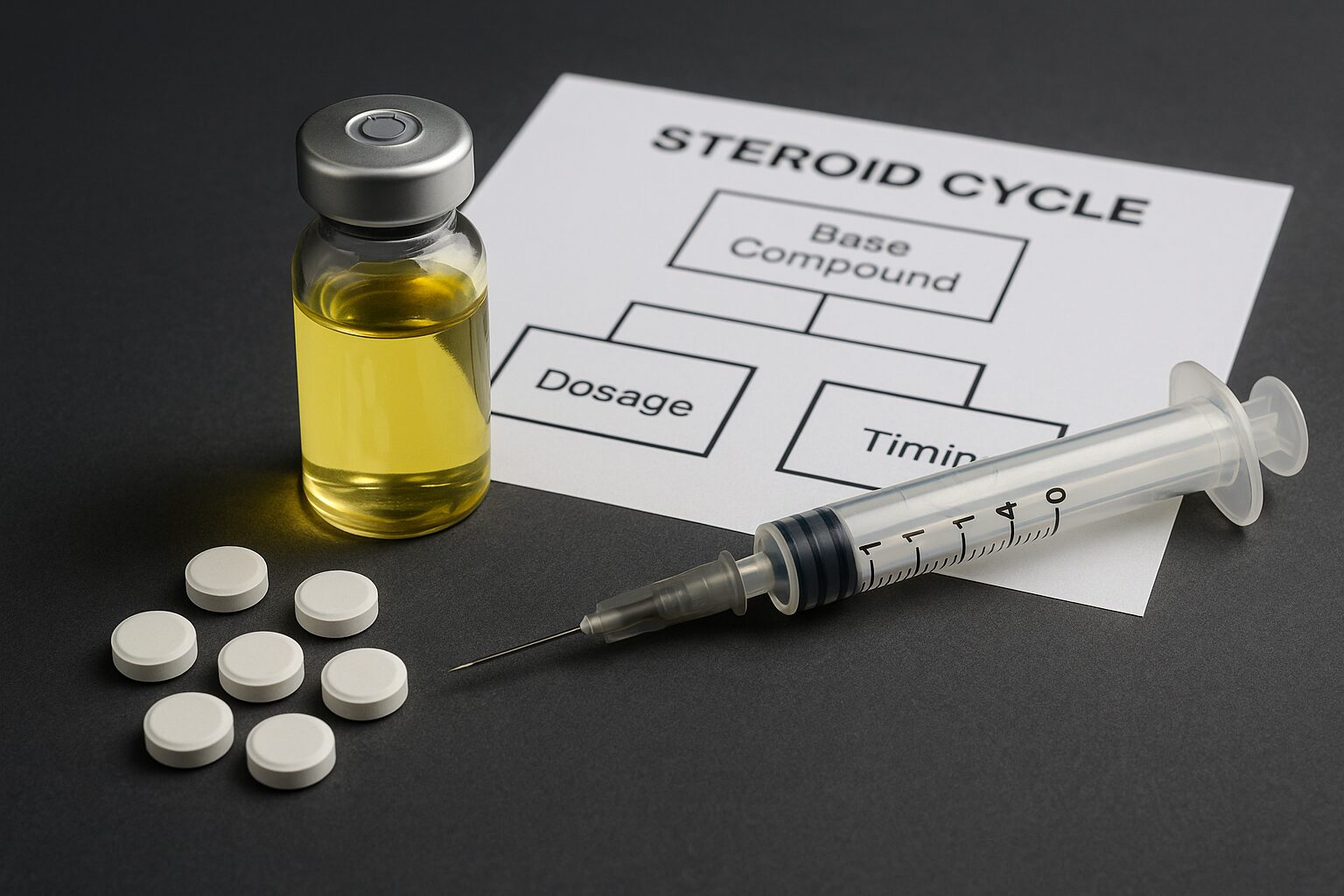
Designing a steroid cycle is one of the most misunderstood aspects of performance enhancement. Online forums, gym conversations, and influencer advice often reduce complex biological realities to simplistic “beginner stacks” or arbitrary dosages. In reality, steroid cycle structure is a combination of pharmacology, endocrinology, risk management, and goal-specific planning. If someone does not understand the science behind cycles, they cannot understand the risks—or the results.
This chapter does not glorify steroid use. Instead, it explains the true reasoning behind why cycles exist, how they are built, and what principles guide stacking and timing. Understanding this logic is essential, whether your goal is to learn, to stay safe, or simply to demystify a topic that many people talk about but few understand.
A steroid cycle is, in essence, a temporary period of controlled hormone manipulation. Users take anabolic compounds for a limited duration, seeking increased muscle growth, strength, recovery, or performance. After this period, they either lower their dose, switch compounds, cruise on testosterone, or attempt to restart natural hormonal function.
The structure of a cycle matters because steroids influence dozens of biological systems: hormones, lipids, blood pressure, red blood cells, neurological drive, liver function, and more. The body adapts rapidly, which means cycles must be carefully planned to maximize benefits while minimizing harm.
Why Cycles Exist: The Core Concept
Unlike natural testosterone production, which is tightly regulated, injecting anabolic steroids overrides the endocrine system. This creates powerful anabolic signals, but also suppresses the body’s own hormonal balance. Because this suppression is inevitable, most users organize their steroid use into cycles, allowing the body time to recover between periods of enhanced hormonal activity.
Without structured cycles, hormone suppression can become permanent, fertility can decline dramatically, and cardiovascular stress can accumulate over time. Cycles exist to limit duration, control dosage, and manage adaptation.
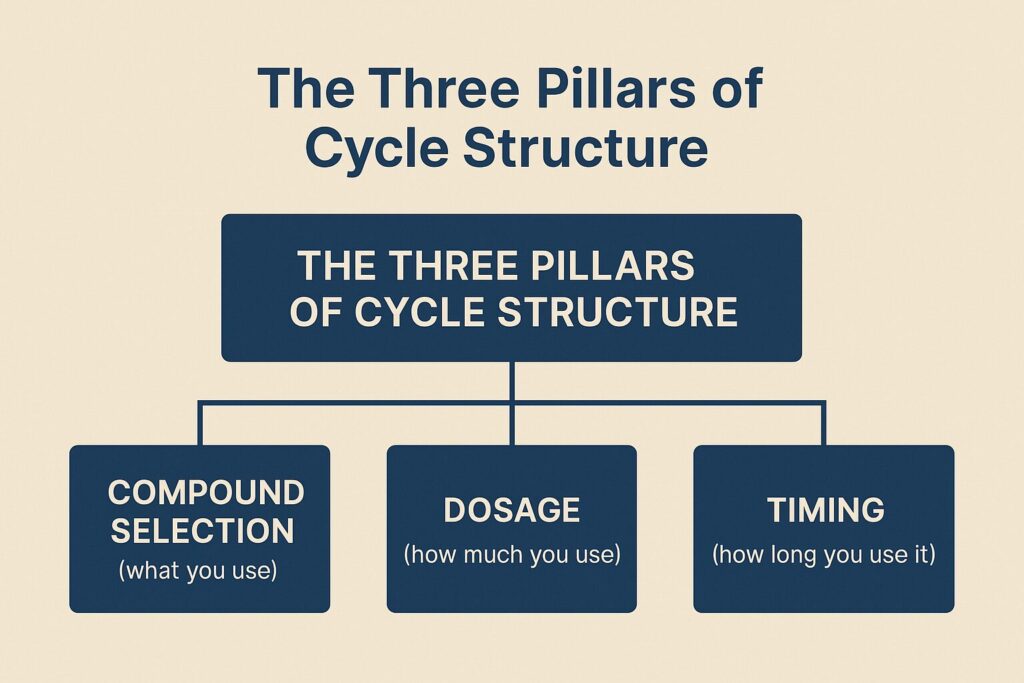
The Three Pillars of Cycle Structure
Every steroid cycle—whether simple or complex—relies on three fundamental variables:
- Compound selection (what you use)
- Dosage (how much you use)
- Timing (how long you use it)
These three pillars determine both results and risks. They also interact with each other: a high dose short cycle carries different risks than a low dose long cycle, and stacking compounds multiplies effects in both positive and negative directions.
Base Compounds: Why Testosterone Is the Foundation
Nearly every structured steroid cycle begins with testosterone. This is not a myth; it’s a biological necessity. When you introduce exogenous hormones, your body shuts down its own testosterone production. If no testosterone source is provided, libido collapses, mood drops, cognitive function declines, and overall well-being is compromised.
This is why testosterone-only cycles are considered the simplest entry point: they teach users how their body responds to hormonal changes before adding complexity.
Most stacked cycles also include testosterone as a baseline hormone, providing physiological balance while other compounds amplify specific effects like mass, strength, or dryness.
Stacking Logic: Why Certain Steroids Are Combined
Stacking—using more than one compound at a time—is common because different steroids target different pathways.
For example:
- Testosterone → overall anabolic base
- DHT derivatives → hardness, density, neural drive
- 19-nors → mass, recovery, strength, collagen synthesis
- Orals → rapid early-phase strength and pumps
Combining compounds allows users to synergize effects without maxing out dosage on a single steroid. The idea is not “more is better,” but rather “different effects without exceeding individual toxicity thresholds.”
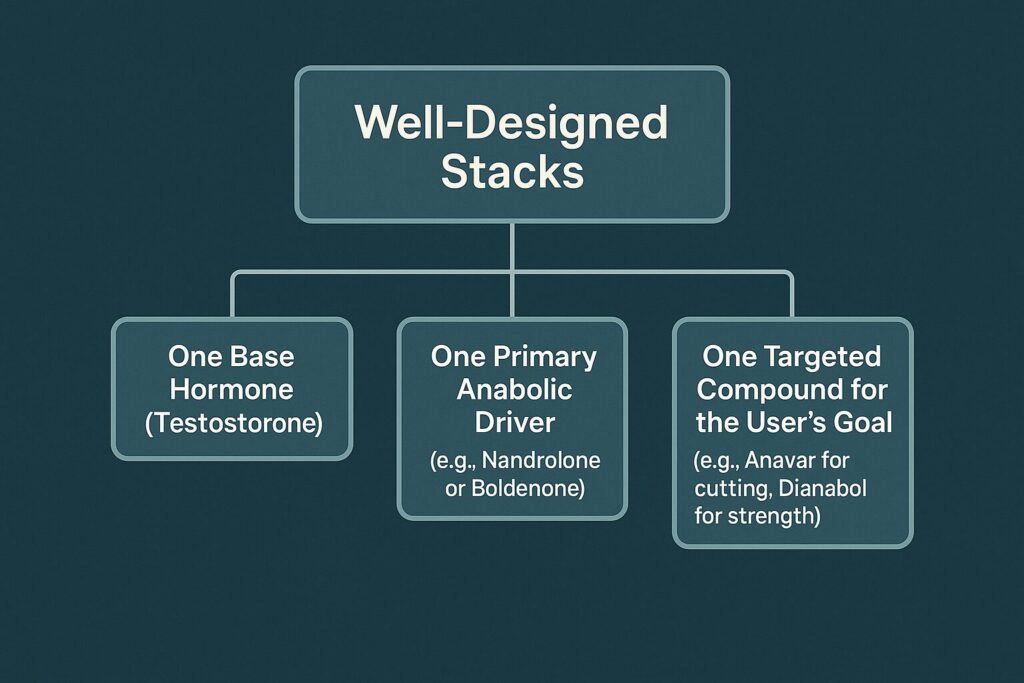
Well-designed stacks typically combine:
- one base hormone (testosterone)
- one primary anabolic driver (e.g., nandrolone or boldenone)
- one targeted compound for the user’s goal (e.g., Anavar for cutting, Dianabol for strength)
However, poorly designed stacks—like combining multiple harsh compounds—dramatically increase side effects without producing proportional benefits.
Dose-Response and Diminishing Returns
Steroids follow the same biological rules as any drug: lower doses produce significant results, while higher doses produce progressively smaller benefits but exponentially higher risks.
At a certain point, increasing dosage only:
- worsens cholesterol
- thickens blood
- damages the liver
- stresses the kidneys
- increases anxiety
- reduces sleep quality
- elevates blood pressure
…without meaningfully improving muscle growth.
This is why experienced users emphasize minimum effective dose rather than maximal risky experiments.
Cycle Length: Why 8–16 Weeks Is Standard
Most injectables require long half-lives, meaning they remain active for many days after injection. Because hormonal changes take time to manifest, cycles usually last between 8 and 16 weeks, depending on compounds and goals.
Short cycles (4–6 weeks) are most common with orals, which act quickly but carry higher toxicity.
Long cycles (12–16 weeks) are typical with long-ester injectables, which provide steady blood levels and predictable outcomes.
Extending cycles beyond this range increases suppression, complicates recovery, and elevates cardiovascular strain.
Frontloading, Kickstarts, and Tapering: The Advanced Timing Tools
Certain techniques exist to manipulate the speed and intensity of a cycle:
Kickstarts
Using fast-acting orals (Dianabol, Anadrol) at the beginning to generate immediate strength and size before injectables peak.
Frontloading
Injecting a higher dose on day one to reach stable blood levels more quickly.
Tapering
Gradually reducing dosage to ease transitions, though many modern protocols skip tapering because of improved post-cycle therapy strategies.
These techniques highlight how timing—not just dosage—impacts outcome.
Why Bloodwork Dictates Everything
No cycle is intelligently designed without:
- baseline bloodwork
- mid-cycle monitoring
- post-cycle evaluation
Bloodwork determines:
- liver stress
- lipid damage
- hematocrit elevation
- estrogen levels
- testosterone suppression
- kidney strain
Without these metrics, cycle design becomes guesswork—dangerous and unnecessary.
Side-Effect Management: The Hidden Half of Cycle Design
Managing estrogen, prolactin, blood pressure, and lipids is as important as the steroids themselves.
Tools commonly used for management include:
- AROMATASE inhibitors to control estrogen
- Dopamine agonists for prolactin (rare and only for certain compounds)
- Blood donation for hematocrit
- Lifestyle modifications to protect cardiovascular health
Understanding side-effect mechanisms is essential because poorly managed hormones can ruin even the best-designed cycle.
The Role of Post-Cycle Therapy (PCT)
Traditional PCT attempts to restart natural testosterone production after suppression. This includes SERMs like clomiphene or tamoxifen. However, PCT is not universally effective, especially after long or harsh cycles. Some users transition instead into cruise protocols, which maintain low-dose testosterone year-round.
Whether someone uses PCT or cruises depends entirely on:
- cycle history
- goals
- age
- endocrine resilience
- fertility considerations
Understanding cycle design requires understanding what happens after the cycle ends.
Why Many Beginners Fail: Common Mistakes
Most cycle failures result from:
- stacking too many compounds
- starting with harsh drugs
- ignoring testosterone
- using random dosages
- skipping bloodwork
- chasing influencer myths
- misunderstanding half-lives
- failing to respect recovery timelines
In other words: a lack of scientific structure.
Cycles Are Not Templates — They’re Strategies
There is no such thing as a universal “best beginner cycle” or “perfect mass cycle.” Every cycle depends on:
- the user’s physiology
- goals
- training age
- cardiovascular health
- tolerance to androgens
- psychological profile
- prior experience
Cycle design is a strategy, not a recipe.
Looking Ahead: Understanding Risks Requires Understanding Cycles
Now that the structure of steroid cycles is clear, it becomes easier to understand the risks, the benefits, and the biochemical consequences of these choices. Every mechanism described here interacts with the pathways we studied in Post 2.
Cycle design is complex because the body is complex.
**Next Up: Post 5 — Post-Cycle Therapy (PCT):
Does It Work, When Does It Fail, and Is It Even Necessary?**
In the next chapter, we break down:
- the real science behind PCT
- how natural testosterone recovery works
- why some people never recover fully
- when PCT makes sense
- when “cruise” protocols take over
- myths vs reality
About the Author

Forge Your Mind. Build Your Biology.
Join the Forge Biology newsletter — where science meets strength.
Every week, you’ll get:
-
Evidence-based insights on training, performance, and recovery
-
Real analyses of supplements that work (and the ones that don’t)
-
Deep dives into hormones, nutrition, and human optimization
No fluff. No marketing hype. Just data-driven knowledge to build a stronger body — and a sharper mind.
Subscribe now and start mastering your biology.