
When athletes talk about being “built for speed” or “born with endurance,” they’re really talking about muscle fiber types. These fibers determine how fast you can sprint, how long you can run, how much force you can generate, and how quickly you fatigue.
But fiber types are not destiny — training can dramatically shift how these fibers behave. To understand how to train smarter, you first need to know what each fiber type does and how your body uses them.
1. The Three Primary Muscle Fiber Types
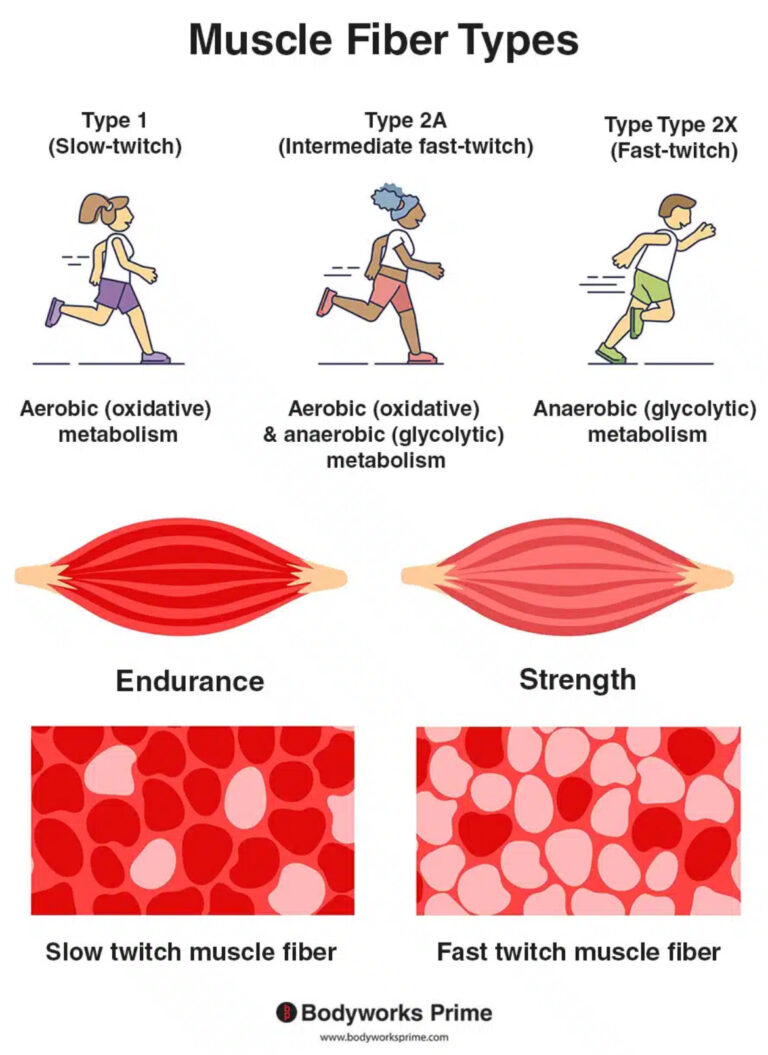
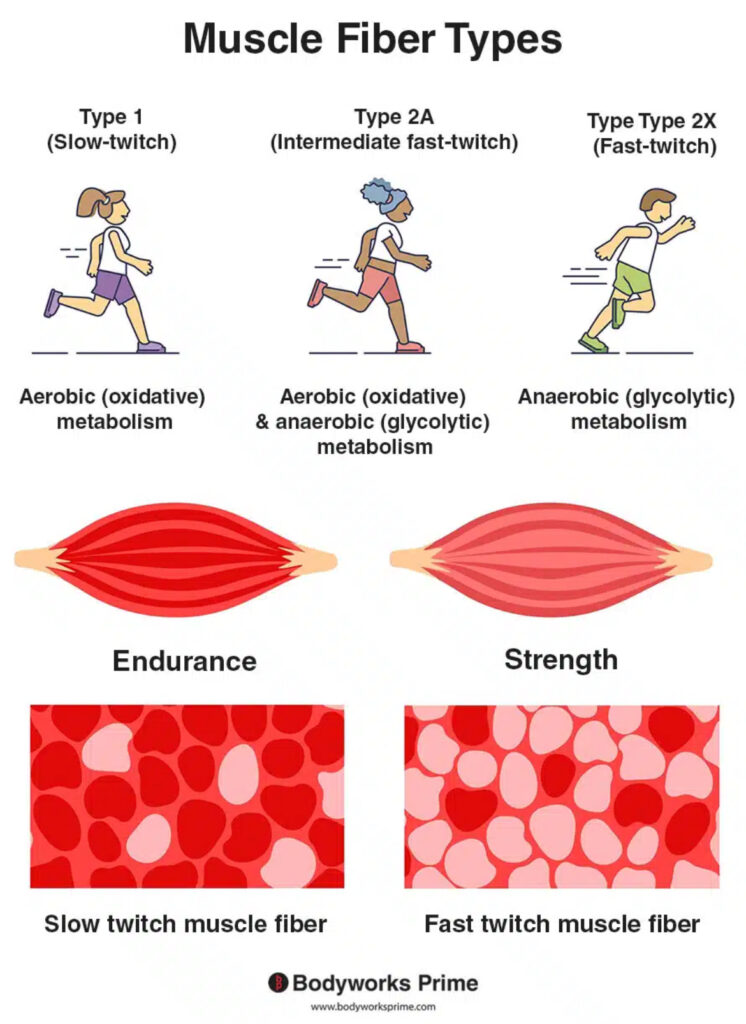
Skeletal muscle is made of three main categories of fibers. Each has unique properties relating to contraction speed, fatigue resistance, metabolic pathways, and athletic potential.
Type I — Slow-Twitch Fibers
Best for: endurance, long-duration efforts
Fuel: primarily aerobic metabolism (oxygen-dependent)
Characteristics:
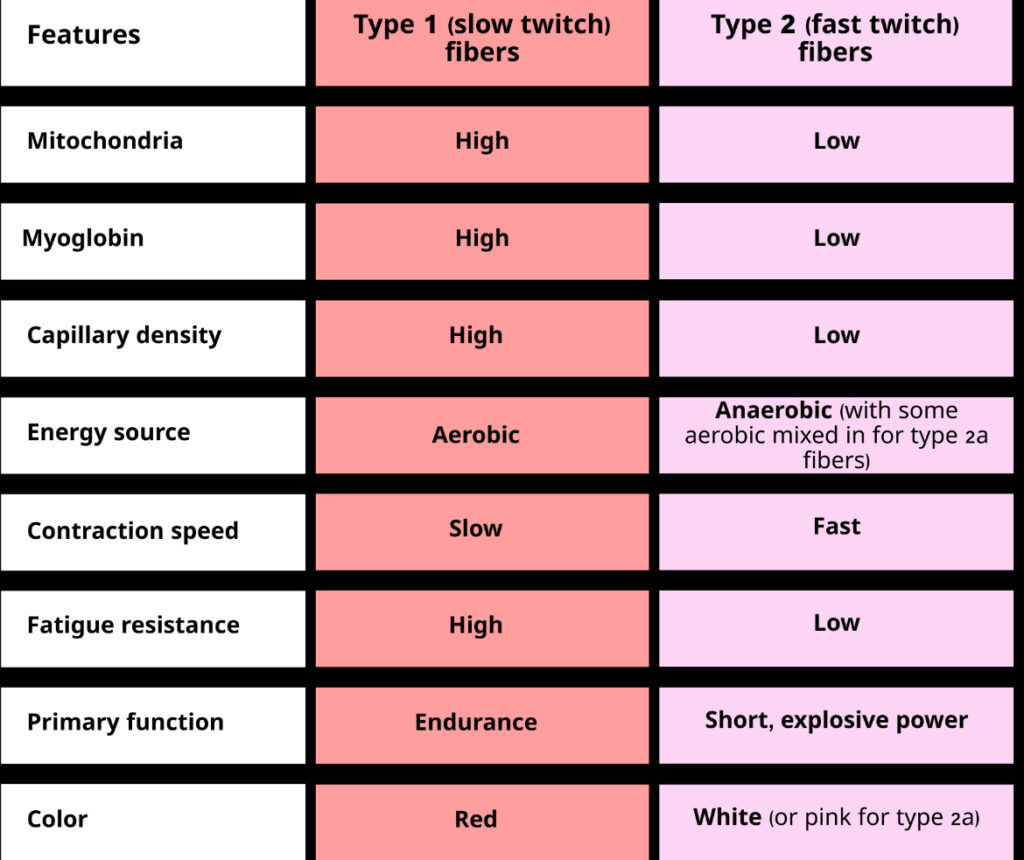
- High mitochondrial density
- High capillary density
- Extremely fatigue-resistant
- Lower force output
These fibers excel in activities requiring sustained output: distance running, cycling, swimming, rucking, and low-intensity lifting. They’re efficient, reliable, and built for the long haul — not maximal speed.
Type IIa — Fast-Twitch Oxidative Fibers
Best for: mixed endurance + power
Fuel: both aerobic and anaerobic pathways
Characteristics:
- Moderate-to-high force output
- Better fatigue resistance than Type IIb
- Highly adaptable
- Respond strongly to strength, power, and conditioning work
These are the hybrid fibers — the most “trainable” type. With endurance work, they behave more like Type I. With heavy lifting or sprints, they behave more like Type IIb. Most athletes rely heavily on this fiber class.
Type IIb (IIx) — Fast-Twitch Glycolytic Fibers
Best for: maximal power and speed
Fuel: anaerobic metabolism
Characteristics:
- Highest force production
- Fastest contraction speed
- Very low fatigue resistance
- Ideal for explosive bursts
These fibers drive sprinting, heavy lifting, jumping, striking, and short, maximal outputs. They produce tremendous force — but only for a brief moment.
Fun fact: In humans, these fibers are usually labeled Type IIx, not IIb as originally believed.
2. What Determines Your Fiber Type Distribution?
You’re born with a genetic baseline, but training heavily influences how your fibers behave.
Genetics
Some people naturally have more fast-twitch fibers (sprinter types), while others have more slow-twitch (endurance types). This affects early athletic tendencies.
Training History
High-volume endurance training increases oxidative capacity and shifts Type IIa fibers closer to Type I behavior.
Explosive training — lifting heavy, sprinting, plyometrics — increases the expression of fast-twitch characteristics.
Age
Aging tends to decrease fast-twitch fiber size and function. Strength training helps preserve them.
Lifestyle
Sedentary individuals lose fast-twitch capability much faster than active individuals.
3. How Training Shapes Fiber Behavior
While you cannot magically convert all your slow-twitch fibers into fast-twitch, you can shift hybrid Type IIa fibers in either direction.
To Improve Endurance
- Zone 2 training
- Tempo runs
- Long intervals
- High-volume resistance training (light/moderate load)
These increase mitochondrial density and capillary growth, improving fatigue resistance.
To Increase Power and Speed
- Heavy lifting (≥80% 1RM)
- Plyometrics
- Sprints
- Olympic lifts
- Low-rep explosive movements
This promotes Type IIx behavior — larger, stronger, faster fibers with more force potential.
To Improve Both (Hybrid Athletes)
- Combine low-intensity aerobic work with high-quality strength sessions
- Avoid chronic high fatigue
- Periodize phases of endurance and power
This approach maximizes the adaptability of the IIa fibers.
4. Why Understanding Fiber Types Matters for Training
Knowing your dominant fiber type can help you:
Plan your workouts more effectively
Explosive athletes benefit more from heavy, fast movements. Endurance athletes need volume and aerobic base work.
Choose exercises that match your goals
Want to jump higher? Train the fast-twitch system.
Want to run farther? Build your slow-twitch endurance.
Optimize recovery
Fast-twitch work creates more fatigue and requires longer rest.
Slow-twitch efforts can be repeated more often.
Perform smarter, not harder
You stop guessing and start training in alignment with physiology.
5. Can You Test Your Muscle Fiber Type?
Yes — several methods exist, ranging from simple to scientific.
1. Performance indicators
- Excellent endurance but weak explosiveness → more Type I
- Strong explosive power but fast fatigue → more Type II
2. Strength-endurance testing
Example:
Perform a set at 80% of your 1RM.
- 10 reps → more Type I
- <7 reps → more Type II
3. Muscle biopsy (gold standard)
Only done in research settings.
4. EMG and power testing
Useful for advanced athletes and labs.
6. Practical Training Recommendations
If you want more strength & power
- Lift heavy (3–6 reps)
- Train explosively
- Sprint
- Reduce excessive cardio
If you want more endurance
- Increase aerobic base work
- Use high-volume, low-intensity lifts
- Use long intervals
If you want athletic balance
- Periodize both strength and endurance
- Focus on Type IIa optimization
- Avoid chronic over-fatigue
Final Thoughts
Muscle fiber types shape your athletic potential — but they don’t set your limits. With smart training, hybrid fibers can transform your performance, making you stronger, faster, and more enduring than you ever thought possible.
The key is understanding what each fiber type does and training with intention.
If you want to build a program tailored to your fiber profile — strength, power, conditioning, or a mix — Forge Biology can help you dive deeper into evidence-based training.
About the Author

Forge Your Mind. Build Your Biology.
Join the Forge Biology newsletter — where science meets strength.
Every week, you’ll get:
-
Evidence-based insights on training, performance, and recovery
-
Real analyses of supplements that work (and the ones that don’t)
-
Deep dives into hormones, nutrition, and human optimization
No fluff. No marketing hype. Just data-driven knowledge to build a stronger body — and a sharper mind.
Subscribe now and start mastering your biology.