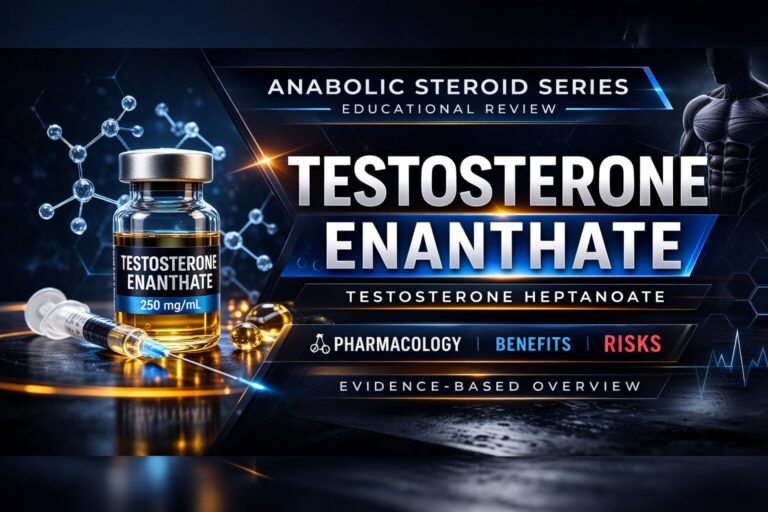



1. What Is Testosterone Enanthate?
Testosterone Enanthate is an injectable esterified form of testosterone, the primary male androgen hormone. The enanthate ester (heptanoate) is attached to the testosterone molecule to slow its release into the bloodstream after intramuscular injection.
It does not change the hormone’s biological function — it changes its pharmacokinetics, extending its duration of action.
Testosterone Enanthate is classified as an anabolic-androgenic steroid (AAS) and is a Schedule III controlled substance in the United States.
2. Historical Development
Testosterone esters were developed in the mid-20th century to improve the practicality of testosterone therapy. Short-acting testosterone required frequent administration, which was inconvenient for patients.
Testosterone Enanthate was introduced in the 1950s as a long-acting depot formulation for the treatment of:
- Male hypogonadism
- Delayed puberty
- Certain cases of muscle-wasting conditions
It became one of the most widely prescribed injectable testosterone preparations worldwide.
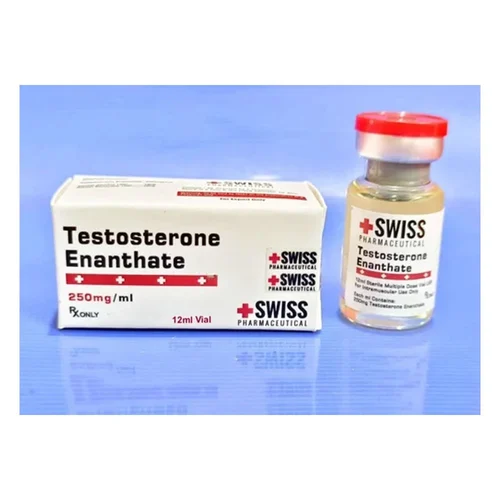
3. Chemical Composition and Pharmacology
- Chemical Name: Testosterone heptanoate
- Molecular Formula: C26H40O3
- Administration Route: Intramuscular injection
- Half-life: Approximately 4–5 days (varies by individual metabolism)
Mechanism of Action
Testosterone binds to androgen receptors in muscle, bone, brain, and other tissues. This activates gene transcription pathways that promote:
- Increased protein synthesis
- Nitrogen retention
- Erythropoiesis (red blood cell production)
- Increased bone density
- Enhanced libido
Metabolic Conversions
Testosterone undergoes two key enzymatic conversions:
- Aromatization → Estradiol (E2)
May contribute to water retention and gynecomastia in susceptible individuals. - 5-alpha reduction → Dihydrotestosterone (DHT)
Associated with androgenic effects such as acne and androgenic alopecia in genetically predisposed individuals.
4. Medical Indications
FDA-approved uses include:
- Primary hypogonadism
- Hypogonadotropic hypogonadism
- Delayed puberty in males
Off-label uses may include:
- Gender-affirming hormone therapy
- Certain catabolic or wasting conditions
5. Pharmaceutical Presentation and Manufacturers
Testosterone Enanthate is typically supplied as:
- Oil-based injectable solution
- Concentrations commonly ranging from 100–250 mg/mL
Major pharmaceutical manufacturers have historically included:
- Pfizer
- Hikma Pharmaceuticals
- Endo Pharmaceuticals
- Various international generics manufacturers
Illicit underground laboratory (UGL) production is common in bodybuilding contexts, which significantly increases risk due to contamination and dosing inaccuracy.
6. Desired Effects (What Users Typically Seek)
Although not medically indicated for physique enhancement, individuals who misuse Testosterone Enanthate often seek:
- Increased lean muscle mass
- Improved strength
- Enhanced recovery
- Increased libido
- Elevated mood and confidence
These effects are dose-dependent and come with proportional risk escalation.
7. Adverse Effects and Risks
Short-Term Risks
- Acne and oily skin
- Fluid retention
- Elevated blood pressure
- Mood instability
- Sleep disturbance
Estrogen-Related Risks
- Gynecomastia
- Increased water retention
Androgenic Risks
- Hair loss (genetic predisposition)
- Prostate enlargement
Cardiovascular Risks
- Reduced HDL cholesterol
- Elevated LDL cholesterol
- Increased hematocrit
- Increased thrombotic risk
Endocrine Suppression
Exogenous testosterone suppresses the hypothalamic-pituitary-gonadal (HPG) axis, leading to:
- Testicular atrophy
- Reduced sperm production
- Potential infertility
Recovery after discontinuation is unpredictable and may be incomplete.
8. Long-Term Health Concerns
Chronic supraphysiological use has been associated with:
- Cardiomyopathy
- Left ventricular hypertrophy
- Increased cardiovascular events
- Psychiatric effects
- Possible hepatic strain (less common with injectables than orals)
9. Laboratory Monitoring (Medical Supervision)
Individuals undergoing legitimate testosterone therapy are typically monitored for:
- Total and free testosterone
- Estradiol
- Hematocrit / hemoglobin
- Lipid panel
- Liver enzymes
- PSA (prostate-specific antigen)
Medical supervision is essential.
10. Legal and Anti-Doping Status
- United States: Schedule III controlled substance
- WADA: Prohibited substance in competitive sports
- Detection possible through testosterone/epitestosterone ratio and isotope ratio mass spectrometry
11. Frequently Asked Questions
Is Testosterone Enanthate “safer” than other testosterone esters?
Safety depends on dose, medical supervision, and individual health status. The ester mainly affects release time, not inherent risk.
Does it permanently shut down natural testosterone production?
Suppression is guaranteed during use. Recovery varies and is not always complete.
Is it medically necessary for muscle gain?
No. Muscle hypertrophy can occur naturally through progressive resistance training and adequate nutrition.
Final Consideration
Testosterone Enanthate is a legitimate medical therapy for specific endocrine disorders. However, non-medical use introduces substantial cardiovascular, endocrine, and psychiatric risks. The magnitude of risk correlates strongly with dose and duration.
About the Author

Forge Your Mind. Build Your Biology.
Join the Forge Biology newsletter — where science meets strength.
Every week, you’ll get:
-
Evidence-based insights on training, performance, and recovery
-
Real analyses of supplements that work (and the ones that don’t)
-
Deep dives into hormones, nutrition, and human optimization
No fluff. No marketing hype. Just data-driven knowledge to build a stronger body — and a sharper mind.
Subscribe now and start mastering your biology.