

Authors summarized: William J. Kraemer, PhD, CSCS; Jason D. Vescovi, MS, CSCS; and Patrick Dixon, CSCS — University of Connecticut
Original Source: Strength and Conditioning Journal, Vol. 26 (2), April 2004.
Introduction: Wrestling as a Physiological Laboratory
Few sports test the human body as completely as wrestling.
A single six-minute match can push cardiovascular, metabolic, and neuromuscular systems to their limits — demanding high-intensity power output, isometric strength, and technical precision under extreme fatigue.
In their landmark paper, The Physiological Basis of Wrestling: Implications for Conditioning Programs, Kraemer, Vescovi, and Dixon (2004) explored the biological mechanisms behind elite wrestling performance.
Their goal was not just to describe what happens during a match, but to translate physiology into better training design — showing coaches and athletes how to condition scientifically, not just harder.
Why This Research Matters
Wrestling is a sport of explosive transitions — from powerful takedowns to static holds, from near-anaerobic bursts to brief recovery moments.
Yet, despite its ancient origins, much of wrestling training had long relied on intuition rather than evidence.
Kraemer and colleagues wanted to answer fundamental questions:
- What physiological systems dominate performance in wrestling?
- How does fatigue accumulate across matches and multi-day tournaments?
- What specific training methods can build the strength, power, and metabolic tolerance required for success?
By combining laboratory data with decades of field experience, the authors outlined one of the most comprehensive frameworks for wrestling conditioning ever published.
Metabolic Chaos: The Body Under Fire
A wrestling match lasts 6–8 minutes, but metabolically it feels like sprinting up a hill while holding your breath.
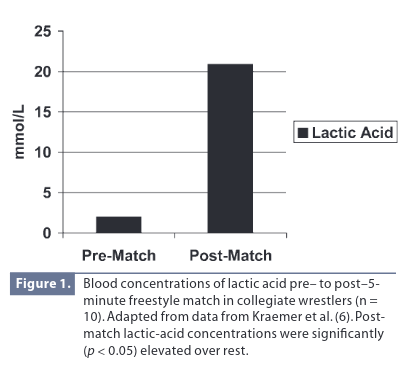
Blood lactate levels routinely exceed 15–20 mmol/L — almost double what most athletes reach during maximal treadmill tests.
This extreme acidosis interferes with the actin-myosin cross-bridge cycle, the microscopic mechanism responsible for muscle contraction.
In plain terms: the more acidic your muscles become, the less force they can generate.
The good news? The body’s buffering systems — bicarbonate and phosphate ions — can adapt through targeted training.
Research shows that 8 weeks of circuit-based resistance training or short-rest interval work can enhance buffering capacity, allowing wrestlers to maintain strength and power longer under fatigue.
From Match to Tournament: The Hidden Fatigue Curve
While one match is brutal, a tournament is physiological warfare.
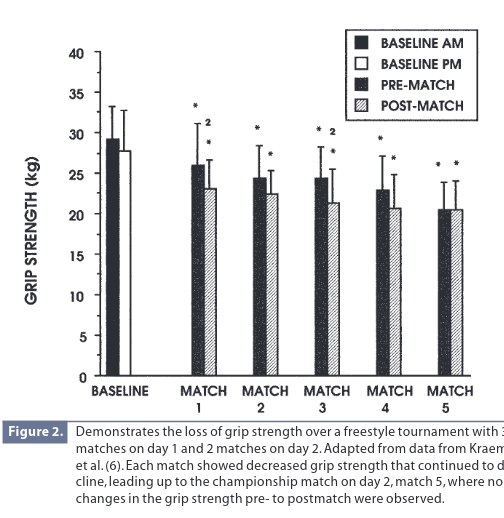
Elite collegiate wrestlers may face 3–6 matches in just 48 hours, producing cumulative fatigue that outpaces recovery.
Kraemer’s lab tracked these athletes and found:
- Isometric strength (grip, bear-hug) declined match after match.
- Testosterone levels dropped to near-adolescent values by the final bout.
- Even with post-weigh-in meals and hydration, wrestlers entered finals in a metabolically compromised state.
The takeaway: Recovery must be trained and planned. Chronic dehydration and rapid weight cutting — still common in lower weight classes — amplify fatigue and suppress hormonal recovery, sabotaging performance.
Strength and Power: The Dual Engine of Dominance
Every successful wrestler shares one foundation: total-body strength and explosive power.
Common technical failures — failing to lift an opponent, incomplete takedowns, or weak hip extension — all stem from insufficient structural strength and power output.
The authors recommend prioritizing multi-joint movements that mirror wrestling’s kinetic demands:
- Squats and split squats
- Lunges and squat jumps
- Power cleans and hang cleans
- One-arm dumbbell cleans and unilateral lifts
Periodization is crucial. Wrestlers should alternate heavy strength blocks (≤6 RM) with power phases (30–85% 1RM, 3–6 reps) to stimulate both ends of the force-velocity curve.
This blend develops not only maximal strength but also the ability to apply it explosively — exactly what determines success in match-ending maneuvers.
Isometric Strength: The Forgotten Weapon
In wrestling, static holds win matches.
A grip that refuses to break, a torso that resists being rolled — these depend on isometric strength, not just dynamic movement.
Traditional lifting develops concentric and eccentric power but neglects static tension.
Kraemer’s team recommends integrating maximal voluntary isometric actions (MVMA) — 3- to 10-second efforts at 100% intensity — performed at joint-angle increments of 10–20 degrees to cover key positions.
Examples include:
- Straight-arm or bear-hug holds (15–20 reps)
- Finger cup and wrist-grip isometrics
- Rope climbs and static chin-holds
Regular inclusion of these drills enhances grip endurance and upper-body stability — critical in both offense and defense.
Periodization: Building the Season Like a Scientist
The researchers advocate a year-round structure divided into four phases:
- Active Rest: light movement, flexibility, recovery from competition.
- Off-Season: foundational hypertrophy and general strength.
- Pre-Season: circuit and interval work to build metabolic tolerance.
- In-Season: maintenance of power and injury prevention under reduced load.
Each phase manipulates volume, intensity, and rest intervals to synchronize peak performance with competition demands — a concept known as linear or undulating periodization.
Training Methods in Practice
1. Circuit Resistance Training
Goal: Improve acid-buffering and muscular endurance.
- 10–15 RM loads
- 60–90 s rest between exercises
- 2–5 circuits per session
Typical exercises: squats, bench press, lunges, pull-downs, rows, cleans.
2. Maximal Strength Training
Goal: Build foundational total-body force.
- 2–4 min rest intervals
- 6 RM or lower loads
- Focus on multi-planar lifts (squats, deadlifts, presses, rows).
3. Power Training
Goal: Maximize velocity and explosiveness.
- 30–85% 1RM, 3–4 reps
- Include Olympic lifts, jump squats, and unilateral variations.
4. Plyometric Training
Goal: Refine coordination and reactive power.
- Progress from two-legged jumps to rotational single-leg bounds.
- Integrate medicine-ball throws and plyometric push-ups for upper body.
5. Injury Prevention and Isometric Work
Goal: Reinforce vulnerable joints and prevent overuse injuries.
- Rotator cuff, neck, and core stability drills.
- Isometric bear-hugs and hand-grip sequences.
Practical Implications for Coaches and Athletes
- Train for the metabolic chaos you compete in.
Simulate fatigue using short-rest circuits and finish sessions with full-body power work. - Respect recovery.
Multi-day tournaments drain hormonal and muscular reserves; plan nutrition, sleep, and hydration accordingly. - Strength under fatigue matters more than strength alone.
Build the ability to sustain power output late in a match — that’s where championships are decided. - Periodize with purpose.
Don’t guess. Structure the year to build foundations first, then sharpen power and resilience. - Prevent injuries through prehabilitation.
Focus on isometric and stabilizing drills for the shoulders, knees, and neck.
Scientific Discussion: Integrating Strength, Endurance, and Biochemistry
The physiological stress of wrestling combines anaerobic glycolysis, lactic acid accumulation, and neuromuscular fatigue.
What differentiates elite wrestlers isn’t their ability to avoid fatigue — it’s their ability to perform despite it.
By blending strength and metabolic conditioning, athletes up-regulate mitochondrial enzymes, improve hydrogen-ion buffering, and sustain ATP regeneration.
This cellular adaptation translates directly to higher technical efficiency, reduced performance decline, and better recovery between bouts.
From a biochemical standpoint, well-conditioned wrestlers maintain a more stable pH and delay the onset of neuromuscular inhibition, allowing for faster, stronger, and more precise execution even in the dying seconds of a match.
Wrestling Through the Lens of Physiology
Kraemer, Vescovi, and Dixon’s work remains one of the foundational texts connecting sports physiology and applied wrestling performance.
Their findings highlight a simple truth: wrestling excellence is not built on brute effort alone — it is engineered through scientific conditioning.
By training the body’s energy systems, strength capacities, and recovery mechanisms in concert, athletes can reach new levels of endurance and resilience.
In a sport decided by milliseconds and millimeters, physiology is the invisible edge that separates the good from the great.
About the Author

Forge Your Mind. Build Your Biology.
Join the Forge Biology newsletter — where science meets strength.
Every week, you’ll get:
-
Evidence-based insights on training, performance, and recovery
-
Real analyses of supplements that work (and the ones that don’t)
-
Deep dives into hormones, nutrition, and human optimization
No fluff. No marketing hype. Just data-driven knowledge to build a stronger body — and a sharper mind.
Subscribe now and start mastering your biology.