
Introduction: How Far Can the Human Body Go Without Food?
Throughout human history, food scarcity was the rule, not the exception. Our ancestors survived long periods of starvation while still needing to hunt, travel, and defend themselves. But how does the modern body respond when pushed to the same limits?
In 2025, researchers from Norway, Denmark, and the United Kingdom published a landmark study in Nature Communications that took a bold approach to this ancient question. They explored what happens when humans fast for seven consecutive days—not intermittent fasting or calorie restriction, but complete water-only abstinence from food.
The results challenge conventional wisdom about energy, strength, and survival.
The Research Team Behind the Study
The project was led by Professor Jørgen Jensen from the Norwegian School of Sport Sciences, in collaboration with scientists from the University of Copenhagen, Aarhus University, and the University of Cambridge.
The multidisciplinary author list included Kristoffer J. Kolnes, Emelie T. F. Nilsen, Steffen Brufladt, Allison M. Meadows, Per B. Jeppesen, Øyvind Skattebo, Egil I. Johansen, Jesper B. Birk, Kurt Højlund, Janne Hingst, Bjørn S. Skålhegg, Rasmus Kjøbsted, Julian L. Griffin, Anders J. Kolnes, and Stephen O’Rahilly.
Their goal was simple yet profound: to understand how fasting alters human performance and metabolism at both physiological and molecular levels.
Study Design: Seven Days of Water-Only Fasting
Thirteen healthy volunteers—seven men and six women—took part in the experiment. For one full week, they consumed nothing but water while continuing their normal daily routines under medical supervision.
Before and after fasting, the team measured:
- Body composition using DXA scans
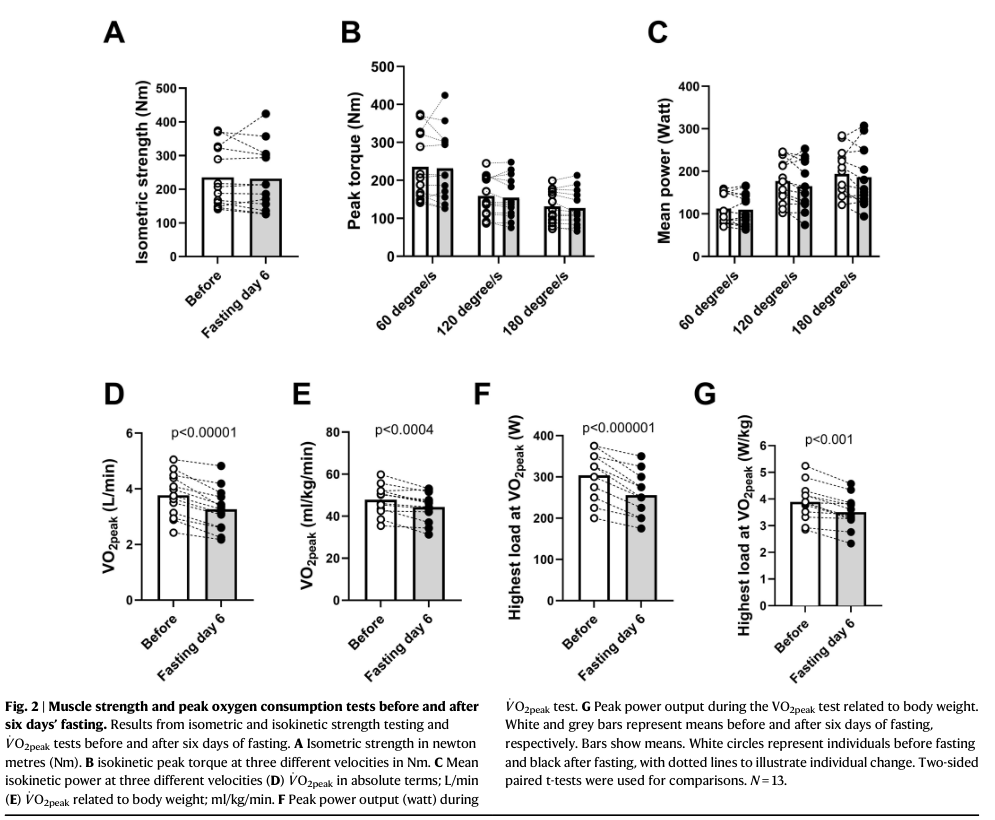
- Muscle strength via isometric and isokinetic leg tests
- Aerobic capacity (VO₂ peak) using graded cycling
- Resting metabolism through indirect calorimetry
- Muscle biopsies for glycogen and enzyme analysis
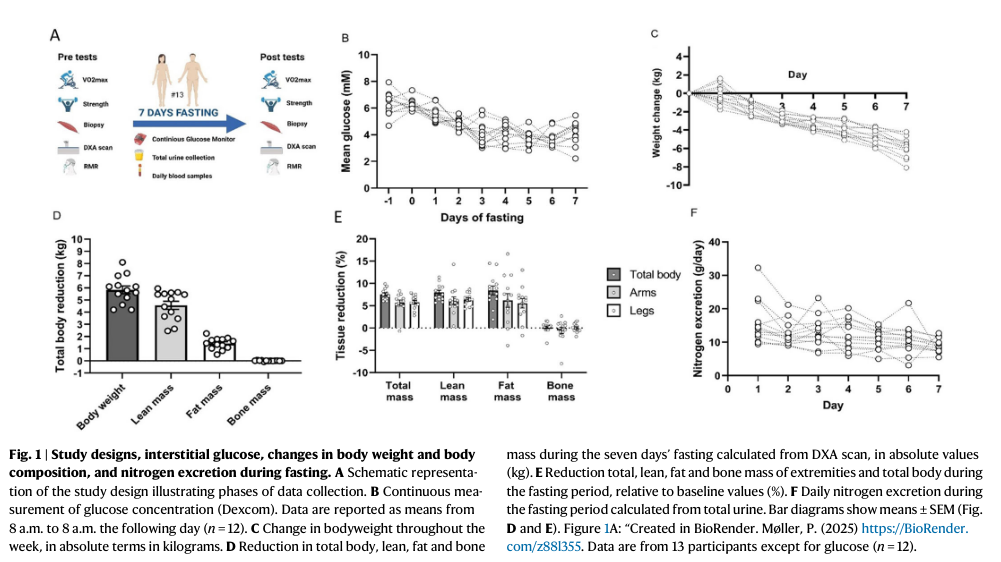
Participants also wore continuous glucose monitors and provided daily urine and blood samples, allowing researchers to map the body’s transition from glucose-burning to fat- and ketone-based metabolism in real time.
Results: Strength Survives, Endurance Declines
After seven days, participants lost an average of 5.8 kilograms (7.5% of their body weight). Most of that loss came from lean tissue (–4.6 kg) and fat (–1.4 kg). Yet remarkably, muscle strength remained intact.
In contrast, endurance capacity fell sharply. Peak oxygen uptake (VO₂ max) decreased by 13%, and total work output dropped by about 15%. In plain terms, the subjects could still lift and move powerfully—but not for as long.
This suggests that during starvation, the body prioritizes short-term survival and mobility over long-term stamina.
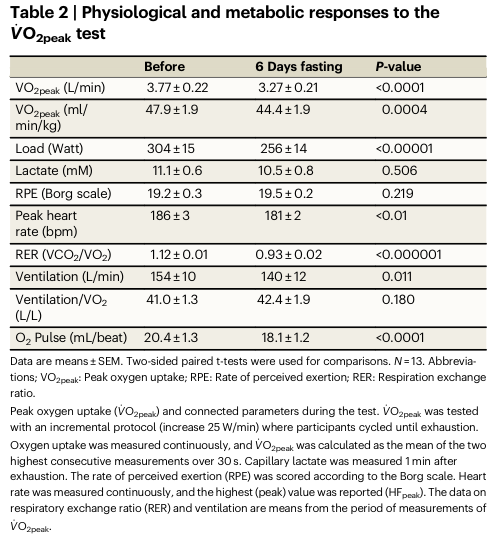
A Molecular Breakthrough: PDK4 and the Energy Switch
When researchers analyzed muscle tissue, they found a biochemical surprise. A single enzyme, pyruvate dehydrogenase kinase 4 (PDK4), increased its expression by 13 times after fasting.
PDK4 acts as a molecular “brake,” shutting down carbohydrate oxidation and forcing the body to use fat and ketones as primary fuels. This adaptation conserves glucose for the brain while maintaining sufficient energy for muscle function.
In other words, fasting reprograms the body to survive—not by conserving energy, but by switching fuels.
The Role of AMPK: A Myth Challenged
For years, scientists believed that AMP-activated protein kinase (AMPK) was responsible for muscle breakdown during fasting. However, this study found no increase in AMPK activity in any of the muscle complexes examined.
This finding challenges a long-standing assumption in metabolic science, suggesting that fasting-induced muscle loss is more nuanced and likely not driven by AMPK signaling alone.
Metabolic Adaptation: Fat Up, Carbs Down
Resting metabolism did not slow down after fasting. Instead, fuel sources shifted dramatically:
- Fat oxidation increased from 37% to 73% of total energy use.
- Carbohydrate contribution dropped from 53% to 19%.
- Muscle glycogen decreased by about 50%.
The body essentially became a fat-burning machine, running efficiently on stored energy reserves. Yet this adaptation came with a cost—reduced aerobic performance and faster fatigue during high-intensity exercise.
Evolutionary Perspective: Built to Survive Hunger
From an evolutionary standpoint, these results make perfect sense. Early humans often went days without food but still needed to remain physically capable to secure the next meal.
By preserving strength and sacrificing endurance, the body ensures survival during famine. It’s an ancient biological trade-off encoded in our DNA: stay strong enough to hunt, but conserve fuel for vital organs.
Clinical and Athletic Implications
The findings open the door to new questions about how fasting can be used in modern life:
- For health: understanding fat oxidation may help treat obesity, insulin resistance, and type 2 diabetes.
- For longevity: fasting may mimic beneficial stress responses without causing significant muscle loss.
- For athletes: strategic fasting could enhance metabolic flexibility, though it reduces endurance performance.
The study also demonstrates that weeklong fasts can be conducted safely under controlled conditions, with no serious side effects reported.
Key Takeaways
- Muscle strength was preserved after seven days of fasting.
- Endurance and VO₂ max decreased by around 13–15%.
- PDK4 expression increased 13-fold, reducing carbohydrate oxidation.
- Fat oxidation nearly doubled.
- AMPK activity remained unchanged, challenging old theories.
- Evolutionary adaptation: humans can sustain strength even in starvation.
]
The Resilience of the Human Body
This Nature Communications study is a milestone in human physiology, showing that the body’s reaction to fasting is not simply “slowing down.” Instead, it’s a highly strategic recalibration of energy systems.
After seven days without food, humans remain remarkably strong—but they become metabolically transformed, switching from glucose to fat as their main fuel. The experiment reveals that fasting doesn’t weaken us—it reshapes us.
In the words of the researchers, our ability to “search and hunt for food” during starvation may be one of the oldest survival skills in our species’ evolution.
Source:
Kolnes, K. J., Nilsen, E. T. F., Brufladt, S., Meadows, A. M., Jeppesen, P. B., Skattebo, Ø., Johansen, E. I., Birk, J. B., Højlund, K., Hingst, J., Skålhegg, B. S., Kjøbsted, R., Griffin, J. L., Kolnes, A. J., O’Rahilly, S., Wojtaszewski, J. F. P., & Jensen, J. (2025). Effects of seven days’ fasting on physical performance and metabolic adaptation during exercise in humans. Nature Communications, 16(122).
About the Author

Forge Your Mind. Build Your Biology.
Join the Forge Biology newsletter — where science meets strength.
Every week, you’ll get:
-
Evidence-based insights on training, performance, and recovery
-
Real analyses of supplements that work (and the ones that don’t)
-
Deep dives into hormones, nutrition, and human optimization
No fluff. No marketing hype. Just data-driven knowledge to build a stronger body — and a sharper mind.
Subscribe now and start mastering your biology.