
Understanding how anabolic steroids work is the key to understanding everything else: the benefits, the risks, the side effects, the dramatic strength increases, and the reason these compounds produce results that natural lifters simply cannot replicate. This article goes far beyond the surface-level explanations you often see online. Here, we dive into the true biochemical mechanisms that make anabolic steroids such powerful agents of physical transformation.
While Post 1 explored what anabolic steroids are, this chapter explains what they do—from the moment they enter the bloodstream to the moment they bind to your cells and alter the way your body builds muscle. The science is fascinating, surprisingly elegant, and essential for anyone evaluating the reality of steroid use.
The Journey Begins: Absorption and Entry Into the Bloodstream
Once administered—whether through injection or oral ingestion—anabolic steroids enter the bloodstream and circulate throughout the body. Injectables slowly release from the muscle, while orals pass through the liver first. Despite the different paths, both forms eventually reach systemic circulation.
At this stage, steroids are essentially chemical messengers looking for their target: androgen receptors.
The Androgen Receptor: The Doorway to Muscle Growth
The androgen receptor (AR) is the heart of the process. Every anabolic steroid works through this receptor. Think of the AR as a “master switch” inside your cells. When a steroid molecule finds and binds to this receptor, it creates a powerful chain reaction that changes how the cell behaves.
The AR is found in many tissues—skin, bone, nerves—but the most important for lifters is inside skeletal muscle fibers.
When steroids bind to these receptors, everything changes.
Gene Expression: Turning Muscle-Building Programs ON
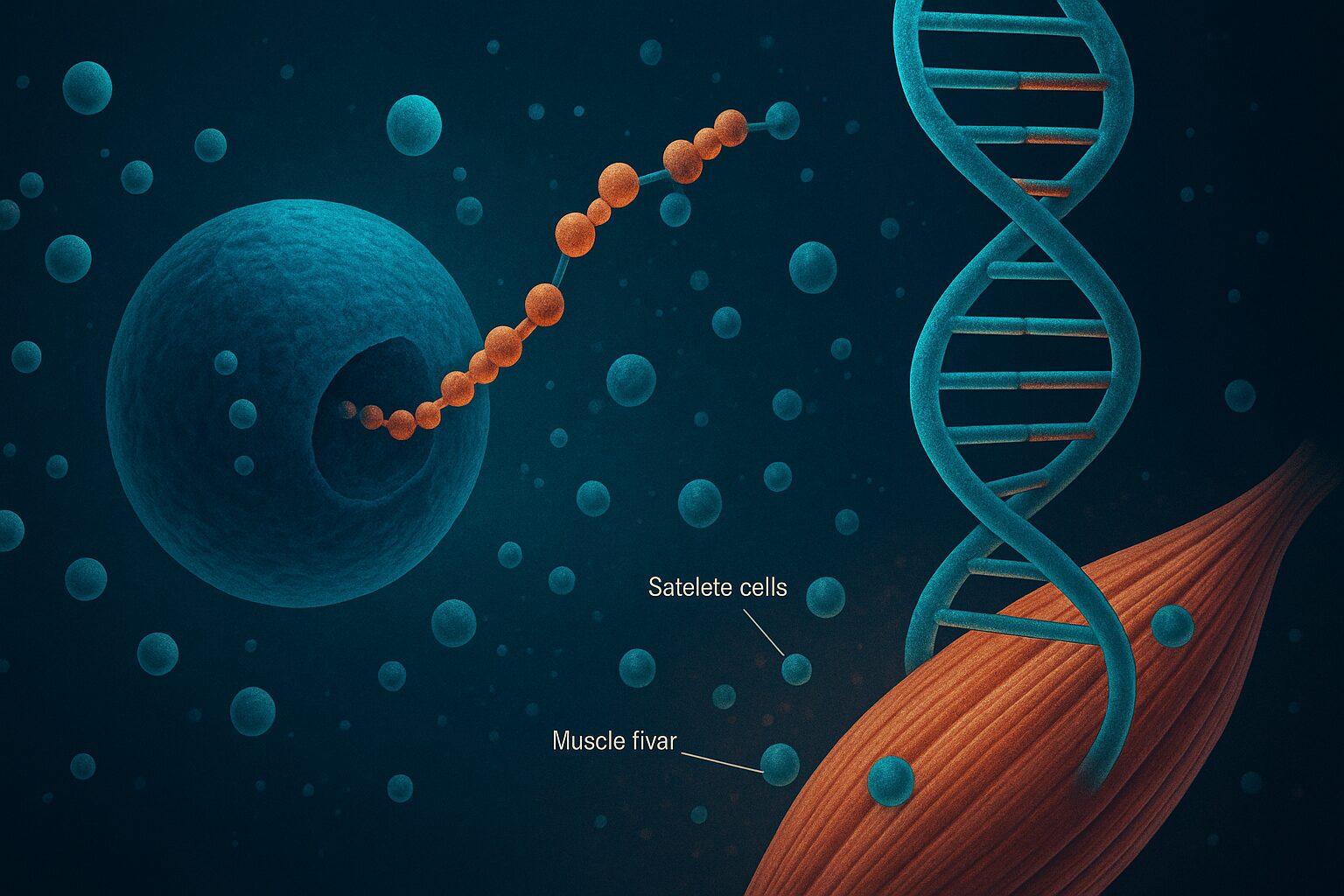
Once an anabolic steroid binds to the androgen receptor, the AR-steroid complex travels into the nucleus of the muscle cell. This is where DNA is stored—and where the real magic happens.
The complex then acts as a transcription factor, meaning it turns certain genes on or off.
Specifically, it activates genes related to:
- muscle protein synthesis
- satellite cell activation
- tissue repair
- anti-catabolic pathways
- growth factors
This is not a small change. This is a fundamental rewriting of how the muscle cell operates. Natural testosterone can activate these pathways, but anabolic steroids amplify them dramatically beyond physiological limits.
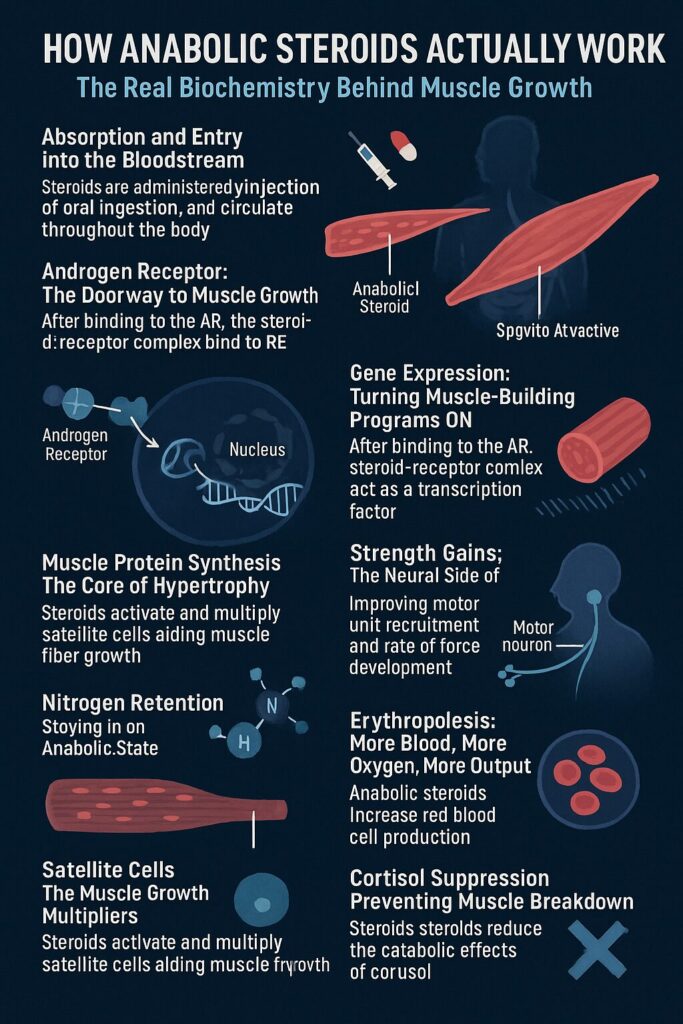
Muscle Protein Synthesis: The Core of Hypertrophy
Protein synthesis is the process through which muscles repair and grow after training. Natural lifters experience spikes in protein synthesis that last 24–48 hours after a workout. Anabolic steroids change the rules.
They increase the magnitude, duration, and consistency of protein synthesis.
Under anabolic steroids:
- muscle repair is faster
- new muscle tissue forms more rapidly
- training frequency can increase
- recovery demands decrease
- progress becomes significantly more linear
This is why a lifter on steroids can grow on training volumes that would destroy a natural athlete.
Nitrogen Retention: Staying in an Anabolic State
Nitrogen is an essential part of amino acids—the building blocks of protein. A positive nitrogen balance means the body has the capacity to build muscle. A negative balance means the body is breaking muscle down.
Anabolic steroids radically improve nitrogen retention.
This alone increases the body’s ability to add lean mass—because it minimizes catabolism even during caloric deficits or intense training. For cutting phases, this is why steroid-assisted athletes retain more muscle while losing fat.
Satellite Cells: The Muscle Growth Multipliers
Satellite cells are adult stem cells that help muscle fibers grow. Without them, hypertrophy is extremely limited. Anabolic steroids activate and multiply satellite cells, enabling:
- repair of damaged fibers
- formation of additional nuclei
- expansion of muscle fiber volume
Natural lifters hit a ceiling—partly because satellite cell activation is limited. Steroids push through that ceiling by enhancing muscle-cell regeneration at a structural level.
Strength Gains: The Neural Side of Steroids
Many people assume steroids work only on muscle size. This is not true. Steroids also improve the neurological components of strength, including:
- motor unit recruitment
- rate of force development
- firing frequency
- coordination of agonist–antagonist muscle groups
Strength increases faster than size because the nervous system adapts before hypertrophy becomes visible. This is why lifters often see strength gains within days or weeks of starting a cycle.
Erythropoiesis: More Blood, More Oxygen, More Output
Anabolic steroids increase red blood cell production. More RBCs means:
- better oxygen delivery
- improved endurance
- faster recovery between sets
- greater work capacity
- stronger pumps
This mechanism is similar to how endurance athletes benefit from EPO—but steroids provide it naturally through hormonal pathways.
Cortisol Suppression: Preventing Muscle Breakdown
Cortisol is the body’s primary catabolic hormone. It breaks down muscle tissue during stress, dieting, or overtraining. Anabolic steroids reduce the muscle-wasting effects of cortisol, creating a powerful anti-catabolic environment.
For cutting phases, this is invaluable. Even in a caloric deficit, steroid users retain disproportionately more muscle because cortisol’s impact is blunted.
Why Steroid Gains Are So Dramatic
When you combine:
- enhanced protein synthesis
- improved nitrogen retention
- satellite cell activation
- better erythropoiesis
- cortisol suppression
- altered gene expression
…you create a biological environment where muscle is not just repaired—it is rebuilt, remodeled, and expanded at a rate far beyond natural limitations.
This is why anabolic steroids produce changes in 12 weeks that many natural lifters never experience in years.
The Limitations of Natural Physiology
Natural athletes are limited by:
- hormonal ceilings
- protein synthesis duration
- nitrogen balance
- satellite cell availability
- recovery capacity
- genetic receptor density
Steroids override these limitations by altering the molecular landscape. They turn “normal” physiology into super-physiology.
Why Mechanisms Matter for Understanding Risks
Understanding the biochemistry also clarifies why steroids carry risks.
Every mechanism that enhances performance can also:
- strain organs
- alter lipids
- affect blood pressure
- disrupt natural hormones
- increase inflammation
- modify psychological states
The same pathways that make steroids powerful also make them dangerous when misused.
Knowledge is not encouragement—knowledge is harm reduction.
Why This Science Matters
If someone does not understand these mechanisms, they cannot understand:
- why dosage matters
- why stacking changes effects
- why certain compounds carry extreme risks
- why recovery changes so dramatically
- why natural and enhanced athletes live in different biological realities
This chapter explains the “why” behind everything that comes next.
Up Next: Post 3 — The Main Types of Anabolic Steroids
In the next chapter, we break down each major steroid family:
- Testosterone esters
- DHT derivatives
- 19-nor compounds
- oral alkylated steroids
…their effects, risks, and why lifters choose them.
About the Author

Forge Your Mind. Build Your Biology.
Join the Forge Biology newsletter — where science meets strength.
Every week, you’ll get:
-
Evidence-based insights on training, performance, and recovery
-
Real analyses of supplements that work (and the ones that don’t)
-
Deep dives into hormones, nutrition, and human optimization
No fluff. No marketing hype. Just data-driven knowledge to build a stronger body — and a sharper mind.
Subscribe now and start mastering your biology.