
Does It Work, When Does It Fail, and Is It Even Necessary?**
Post-Cycle Therapy—commonly known as PCT—is one of the most misunderstood aspects of anabolic steroid use. Some treat it like a magical solution that “resets” the body after a cycle. Others think it’s unnecessary. And many users are shocked to learn that PCT often fails, leaving them with long-term hormonal dysfunction they never expected.
This chapter is not about glamorizing or promoting steroid use. It is about understanding the real science behind how hormonal recovery works—and why PCT is far more complex than bro-science forums suggest.
To understand PCT, you must first understand what a steroid cycle does to the endocrine system. Whenever exogenous testosterone or other suppressive anabolic steroids enter the bloodstream, the brain shuts down natural hormone production. The hypothalamus and pituitary no longer release the signals that tell the testes to produce testosterone. This is not a side effect—it is the expected, unavoidable biological response.
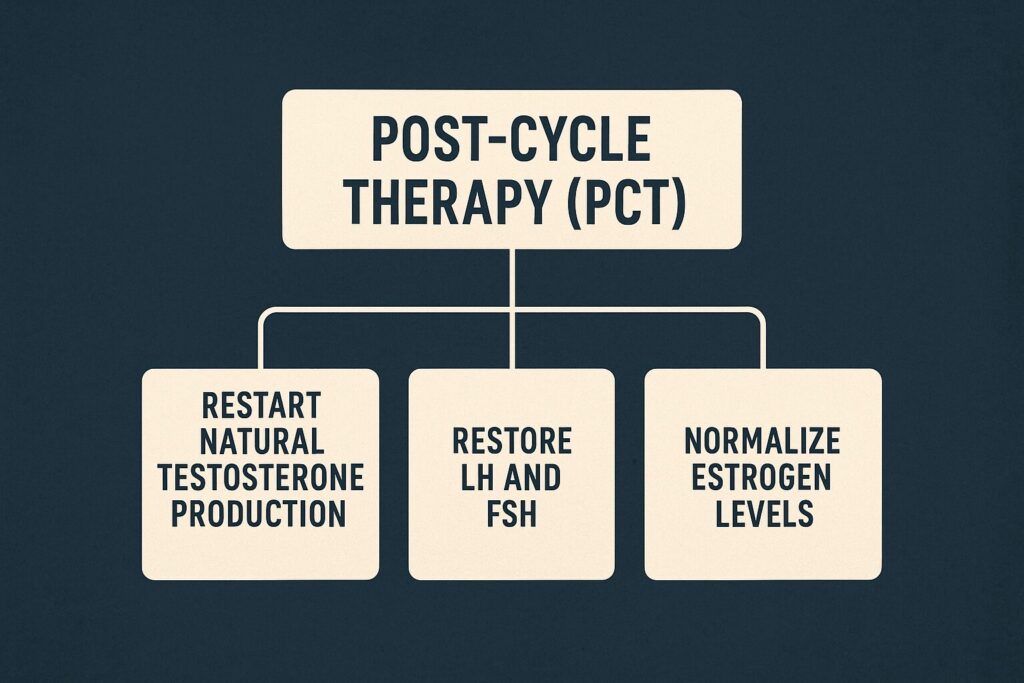
The goal of PCT is to reverse that suppression by stimulating the HPTA axis—the hypothalamus, pituitary, and testes—to restart natural testosterone production. Sounds simple. It isn’t.
PCT works only under specific conditions, at specific times, with specific compounds. And even then, full recovery is not guaranteed.
Why Steroid Suppression Happens in the First Place
Steroids suppress the HPTA because the body senses high levels of androgen in the bloodstream. When androgen is high, the brain’s natural response is to stop producing GnRH (gonadotropin-releasing hormone). Without GnRH, the pituitary stops producing LH and FSH. Without LH and FSH, the testes stop producing testosterone and sperm.
This hormonal shutdown can occur with:
- testosterone
- nandrolone
- trenbolone
- all oral steroids
- even mild compounds like Anavar
PCT tries to initiate a “restart,” but depending on the severity of suppression, the success rate varies dramatically.
The Main Goal of PCT
A proper PCT aims to:
- Restart natural testosterone production
- Restore LH and FSH
- Normalize estrogen levels
- Prevent prolonged hypogonadism
- Shorten the recovery window
- Reduce symptoms such as fatigue, depression, and low libido
But not all steroids allow this to happen easily. Some compounds make PCT far more challenging—or even unlikely to succeed at all.
Why Timing Is Everything
One of the most common PCT failures occurs because people start too early.
Long-ester compounds such as testosterone enanthate, cypionate, nandrolone decanoate, and trenbolone enanthate remain active for weeks after the final injection. If PCT begins while these hormones are still suppressing the HPTA, the restart attempt collapses instantly.
A proper PCT must wait for hormone levels to drop low enough for the brain to recognize “low androgen,” triggering the need to restart production.
This is why every compound has a different PCT start time:
- Testosterone enanthate: ~14 days
- Nandrolone decanoate: ~21–28 days
- Trenbolone enanthate: ~14–21 days
- Propionate esters: ~5–7 days
- Orals: ~1–3 days
Fail the timing, and the entire therapy becomes useless.
SERM-Based PCT: What It Really Does
The classical PCT relies on SERMs (Selective Estrogen Receptor Modulators), usually:
- Clomiphene citrate (Clomid)
- Tamoxifen citrate (Nolvadex)
These drugs block estrogen receptors in the brain, tricking the hypothalamus into believing estrogen levels are low. This prompts the release of GnRH, which stimulates LH and FSH, eventually restoring testosterone production.
This is the theory.
In practice, PCT works only if:
- the testes are still responsive
- the pituitary is not deeply suppressed
- the individual did not use extremely suppressive steroids
- baseline hormonal health was good
- the cycle was not too long
- the user is not genetically predisposed to slow recovery
Not everyone meets these conditions.
Why PCT Often Fails
Many users experience permanent or long-term low testosterone after steroid use—even with PCT. This is not a myth; it is a documented clinical reality.
PCT fails for several reasons:
1. Long or harsh cycles cause deep suppression
Cycles involving 19-nor compounds (like trenbolone or nandrolone) suppress LH and FSH more aggressively and for longer periods.
2. Age matters
Men over 30 recover more slowly; men over 35 may not fully recover at all.
3. Baseline testosterone may already have been low
PCT cannot fix a hormonal deficiency that existed before steroid use.
4. Some steroids damage Leydig cell function
If the testes lose the ability to produce testosterone efficiently, PCT cannot repair that.
5. Excessive dosages extend suppression windows
Higher doses = longer shutdown.
6. Poor timing destroys the entire process
Starting PCT too early or too late increases chances of failure.
In other words: PCT is not guaranteed.
PCT vs. “Cruising”: Why Many Users Never Stop
The harsh truth is that many modern steroid users do not perform traditional PCT at all. Instead, they transition to a cruise protocol, maintaining low-dose testosterone year-round. This approach:
- avoids the hormonal crash
- maintains consistent well-being
- prevents PCT failure
- reduces psychological withdrawal symptoms
However, cruising also means:
- permanent suppression of natural testosterone
- lifelong dependence on exogenous hormones
- long-term cardiovascular stress
- ongoing medical responsibility
Cruising is not a safer alternative. It is a different lifestyle with different consequences.
Is PCT Even Necessary?
The answer depends on multiple variables:
PCT makes sense when:
- the user is young
- cycles are short
- dosages are reasonable
- compounds are not extremely suppressive
- fertility is a priority
- long-term hormone independence is desired
PCT becomes questionable when:
- cycles are long
- harsh compounds were used
- the user is older
- baseline testosterone was already low
- there is no desire to remain natural between cycles
In short: PCT is valuable, but not universally applicable.
The Symptoms of Failed Recovery
When PCT fails, users may experience:
- low libido
- depression
- brain fog
- chronic fatigue
- erectile dysfunction
- muscle loss
- increased fat mass
- irritability
- insomnia
- hormonal instability
These symptoms can persist for months—or become permanent without medical intervention.
The Role of Bloodwork
No one should enter, execute, or complete PCT without:
- baseline bloodwork
- mid-cycle bloodwork
- post-cycle bloodwork
Testing determines:
- testosterone
- LH and FSH
- estrogen
- prolactin
- SHBG
- liver enzymes
- lipids
- hematocrit
- fertility markers
Without these metrics, PCT becomes guesswork.
PCT Is a Process, Not a Shortcut
The biggest misconception is believing PCT “fixes everything.” It does not.
PCT:
- helps recovery
- accelerates endogenous function
- reduces the depth of hormone crash
…but it cannot guarantee full restoration of natural testosterone.
Steroid use always carries the possibility of permanent suppression.
Accepting that truth is essential to informed decision-making.
**Next Up: — Blast and Cruise, TRT, and Long-Term Use:
The Difference Between Protocols, Real Risks, and Why Some Users Never Come Off**
In the next chapter, we explore:
- the logic behind long-term TRT
- how blast-and-cruise works
- why some users abandon PCT forever
- the biological cost of staying “on”
- the psychological side of never coming off
About the Author

Forge Your Mind. Build Your Biology.
Join the Forge Biology newsletter — where science meets strength.
Every week, you’ll get:
-
Evidence-based insights on training, performance, and recovery
-
Real analyses of supplements that work (and the ones that don’t)
-
Deep dives into hormones, nutrition, and human optimization
No fluff. No marketing hype. Just data-driven knowledge to build a stronger body — and a sharper mind.
Subscribe now and start mastering your biology.