

Among all topics in performance enhancement, few generate more confusion and polarity than Blast & Cruise, TRT (Testosterone Replacement Therapy), and long-term steroid use. These concepts are often mixed together, misunderstood, or deliberately blurred by influencers who downplay the consequences. Yet the distinction between them is critical—not only for health, but for understanding the psychology and physiology of people who choose to remain “on” indefinitely.
This chapter goes beyond the clichés and exposes the real science, the real risks, and the real motivations behind long-term anabolic steroid use. It is not written to encourage or condemn, but to explain the landscape clearly so readers can understand what is happening behind the curtain of modern fitness culture.
What Blast & Cruise Actually Means
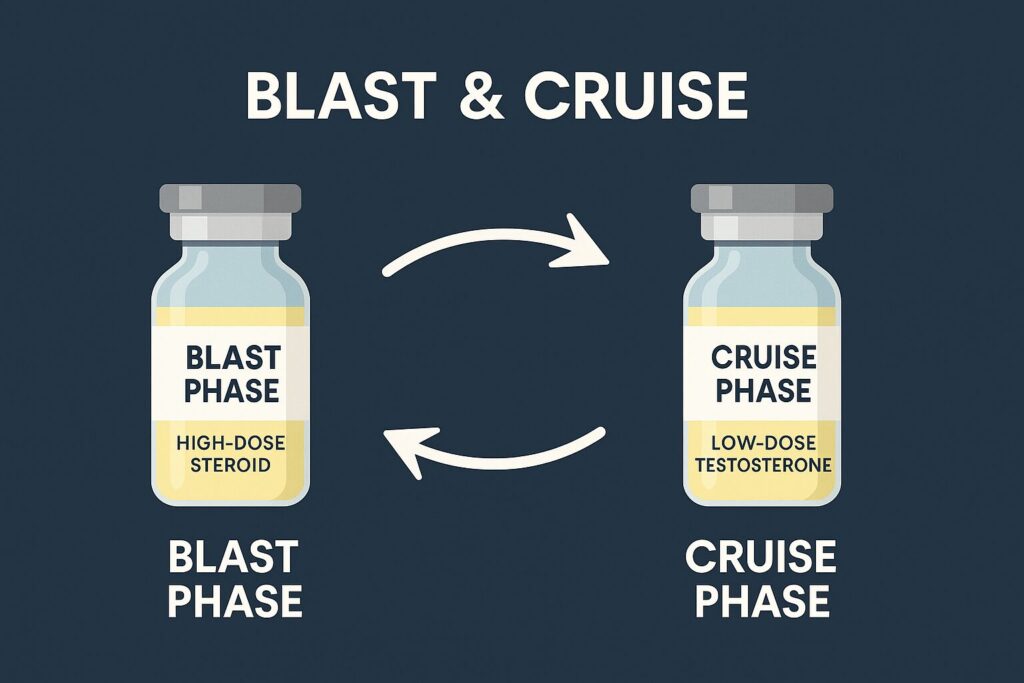
Blast & Cruise is a protocol in which a user alternates between:
- a blast phase (high-dose steroid use for muscle gain or performance)
- a cruise phase (low-dose testosterone to maintain hormone levels)
The key concept is that the user never fully comes off exogenous hormones. There is no attempt at PCT. There is no restart of natural testosterone. The HPTA remains suppressed permanently.
The blast phase is typically 8–16 weeks of higher doses or combinations of anabolic steroids. The cruise phase usually involves TRT-level testosterone, allowing the body a break from supraphysiological levels while maintaining well-being.
How TRT Differs From Blast & Cruise
Testosterone Replacement Therapy (TRT) is a medical treatment, prescribed to individuals diagnosed with low testosterone. The goal is to restore physiological hormone levels—not enhance beyond them.
Differences in intent:
- TRT: restore normal function
- Cruise: maintain exogenous hormone dependence
- Blast: enhance performance to unnatural levels
Many recreational users consider TRT a “normalization phase,” but medically, TRT is meant to be stable, consistent, and not combined with supraphysiological cycles.
Why Some Users Transition Into Permanent TRT
After even a few cycles, some users struggle to recover natural testosterone production. Age, genetics, cycle length, and compound choice all affect the body’s ability to bounce back.
For many, the options become:
- Live with chronically low testosterone,
- Attempt multiple PCT protocols, or
- Begin lifelong TRT or cruising.
Because low testosterone can severely affect mood, libido, mental health, and energy, many choose TRT as the most stable, functional alternative.
But TRT comes with its own long-term responsibilities, risks, and medical requirements.
Why Some Users Prefer Never Coming Off
The decision to remain on exogenous testosterone year-round is rarely only physiological. It is heavily psychological, too. Users often report:
- fear of losing size
- fear of losing strength
- fear of losing identity
- fear of diminished libido
- fear of the depressive crash after cycles
Steroids can make users feel sharper, stronger, more confident, and more driven. Coming off feels like losing part of themselves. For some, using steroids becomes a psychological anchor, making a return to natural levels feel unacceptable.
This emotional dimension is often ignored in discussions about PEDs—but it is one of the most influential factors in long-term use.
The Physiology of Continuous Suppression
Continuous exogenous hormone use suppresses the HPTA indefinitely. Over time, this can lead to:
- reduced endogenous testosterone
- lowered fertility
- testicular atrophy
- dependency on external hormones
- reduced natural libido signals
- decreased LH and FSH to near-zero levels
This means that coming off after years of cycling becomes increasingly difficult—and may be impossible without medical intervention.
The Effects of Long-Term TRT or Cruise Phases
Staying on TRT or a cruise phase year-round is not physiologically neutral. Even at low doses, exogenous testosterone:
- thickens the blood (increased hematocrit)
- impacts lipid profiles
- raises blood pressure
- increases cardiovascular strain
- may enlarge cardiac tissue
- affects prostate health
- alters fertility
- influences mood and emotional regulation
Long-term users often require regular:
- blood donations
- cardiovascular monitoring
- liver and kidney tests
- PSA tests for prostate health
- hormone panels
Without monitoring, silent damage accumulates.
Blast Phases: The High-Risk Component
Blasts involve supraphysiological doses—often multiple steroids stacked together. These phases produce rapid improvements in:
- muscle size
- strength
- aggression
- body composition
But they also multiply risks:
- severe lipid disruption
- high blood pressure
- elevated hematocrit
- increased inflammation
- suppressed fertility
- neuropsychiatric changes
- organ strain
Blasts are where most long-term damage occurs. Cruising simply “pauses” the intensity while maintaining dependence.
Why Recovery Gets Harder Over Time
Long-term steroid use degrades components of the HPTA. Leydig cells, responsible for testosterone production, may lose function. The pituitary becomes less responsive. Some men develop secondary hypogonadism that persists even after stopping steroids entirely.
The longer the cycle history:
- the harder the recovery
- the lower the chance of success
- the more difficult PCT becomes
- the higher the chance of permanent TRT reliance
This is not scare-mongering—it is endocrine physiology.
The Lifestyle Impact: A Hidden Consequence
Blast & Cruise or TRT is not just chemistry—it is a lifestyle commitment. Users must consider:
- regular medical oversight
- lifelong injections
- cost of pharmaceuticals
- long-term cardiovascular planning
- responsibility toward fertility
- permanent hormone dependence
In many ways, Blast & Cruise is closer to hormonal career management than “just taking steroids.” Users are signing up for a future that includes ongoing medical intervention.
The Mental Health Component
Coming off steroids can trigger:
- depression
- anxiety
- lack of motivation
- irritability
- loss of confidence
- identity disturbance
These symptoms push many users back into continuous use. This cycle—feeling good while “on,” feeling miserable while “off”—is a major psychological driver behind permanent TRT adoption.
Understanding this is crucial to understanding long-term users.
TRT as a Safer Alternative? Not Exactly.
TRT is not risk-free. Though controlled, it still carries:
- increased cardiovascular strain
- hematocrit elevation
- lipid profile disruption
- sleep apnea risk
- infertility issues
The difference between TRT and cruising is that TRT aims for physiological hormone levels, while cruising often leads to slightly higher doses, creeping upward over time.
The line between the two can blur quickly.
Why Modern Users Skip PCT Entirely
With increasing knowledge of PCT failure rates, many users choose to:
- blast
- cruise
- repeat
For some, this feels more stable than hormonal rollercoasters. For others, it is a way to maintain a certain physique year-round.
But skipping PCT means accepting:
- permanent suppression
- lifelong hormone replacement
- ongoing health management
This is a major decision—one that should be made with complete understanding.
The Silent Risk: Accumulated Cardiovascular Damage
Decades of research show that long-term androgen use—even at TRT levels—can accelerate:
- atherosclerosis
- blood viscosity
- inflammatory markers
- cardiac tissue remodeling
Most steroid-related deaths are cardiovascular, not hormonal. The challenge with long-term use is not immediate side effects—it’s what accumulates quietly over years.
Long-Term Use: A Serious, Life-Changing Decision
Blast & Cruise is not a hobby. It is not a shortcut. And it is not something to imitate because an influencer looks lean year-round.
It is a physiological commitment with:
- medical implications
- emotional implications
- reproductive implications
- financial implications
- longevity implications
People often begin steroids for aesthetic reasons. They stay because the alternative feels worse. But staying comes with a price.
Understanding this price is essential to understanding modern enhancement culture.
**Next Up: Post 7 — The Real Side Effects of Steroids:
Cardiovascular, Hormonal, Psychological, and Neurological Risks Explained**
In the next chapter, we break down:
- immediate side effects
- long-term damage
- organ-specific risks
- what science says about cardiovascular danger
- psychological and neurochemical changes
- which compounds carry the highest risks
About the Author

Forge Your Mind. Build Your Biology.
Join the Forge Biology newsletter — where science meets strength.
Every week, you’ll get:
-
Evidence-based insights on training, performance, and recovery
-
Real analyses of supplements that work (and the ones that don’t)
-
Deep dives into hormones, nutrition, and human optimization
No fluff. No marketing hype. Just data-driven knowledge to build a stronger body — and a sharper mind.
Subscribe now and start mastering your biology.