


When it comes to training, most people focus on the main workout — the heavy lifts, the sprints, the miles. But the warm-up is where performance truly begins. Skipping it is like trying to run software on a cold computer — inefficient, sluggish, and prone to crash. Understanding why warming up is important is essential for anyone serious about fitness, whether you’re lifting weights, sprinting, or practicing yoga.
Definition: What Is a Warm-Up?
A warm-up is a structured sequence of low-intensity activities designed to gradually prepare the body for physical effort. It increases body temperature, enhances muscle elasticity, and primes the nervous system for efficient movement.
Unlike casual stretching or jogging, an effective warm-up has a purpose: it transitions the body from a state of rest to a state of readiness. It activates the muscles, joints, and cardiovascular system to meet the physical demands of your upcoming workout.
Think of it as the ignition phase — before you can perform at full throttle, the engine needs to reach operating temperature.
Why Warming Up Matters
The physiological changes triggered by a proper warm-up go far beyond just “feeling ready.” Research consistently shows that warming up improves performance and drastically reduces the risk of injury.
When your muscles are cold, they’re stiffer and less responsive. Blood flow is limited, oxygen delivery is slower, and the nervous system isn’t firing at full capacity. A warm-up fixes all that. It raises core and muscle temperature, accelerates heart rate, and activates synovial fluid production in the joints — reducing friction and allowing smoother movement.
In short, warming up prepares your body to perform better and safer.
Benefits of Warming Up
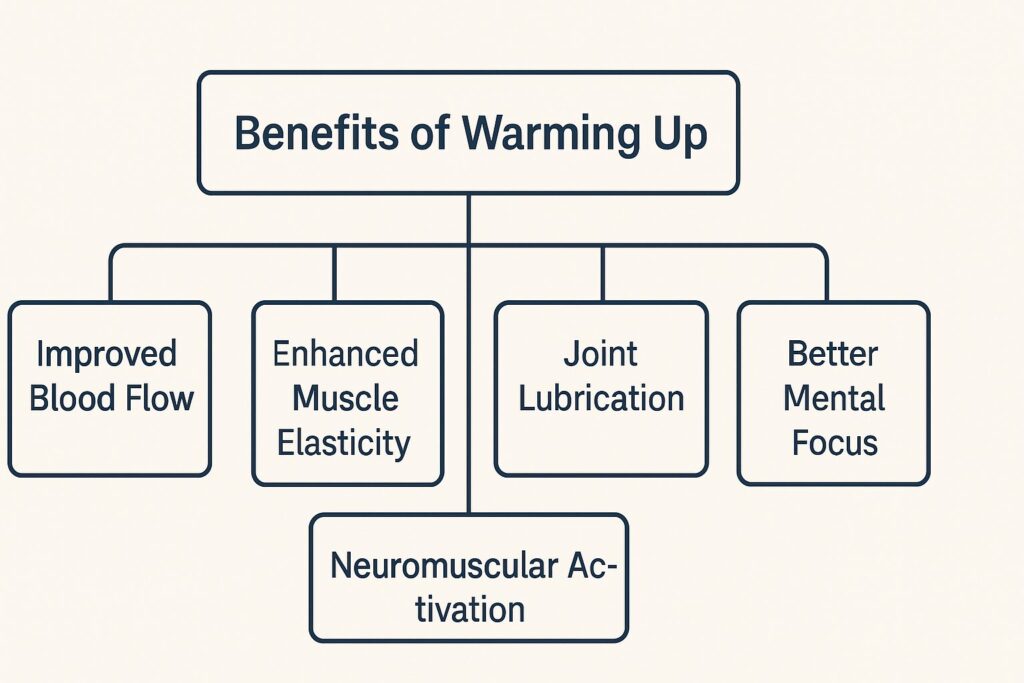
- Improved Blood Flow – Gradual activity increases circulation, ensuring muscles receive oxygen and nutrients efficiently.
- Enhanced Muscle Elasticity – Warm muscles contract more powerfully and stretch more safely.
- Joint Lubrication – Synovial fluid acts like oil in a machine, improving mobility and reducing wear.
- Neuromuscular Activation – A good warm-up “wakes up” the communication between your brain and muscles.
- Better Mental Focus – Warming up transitions your mindset from distraction to determination.
Types of Warm-Up
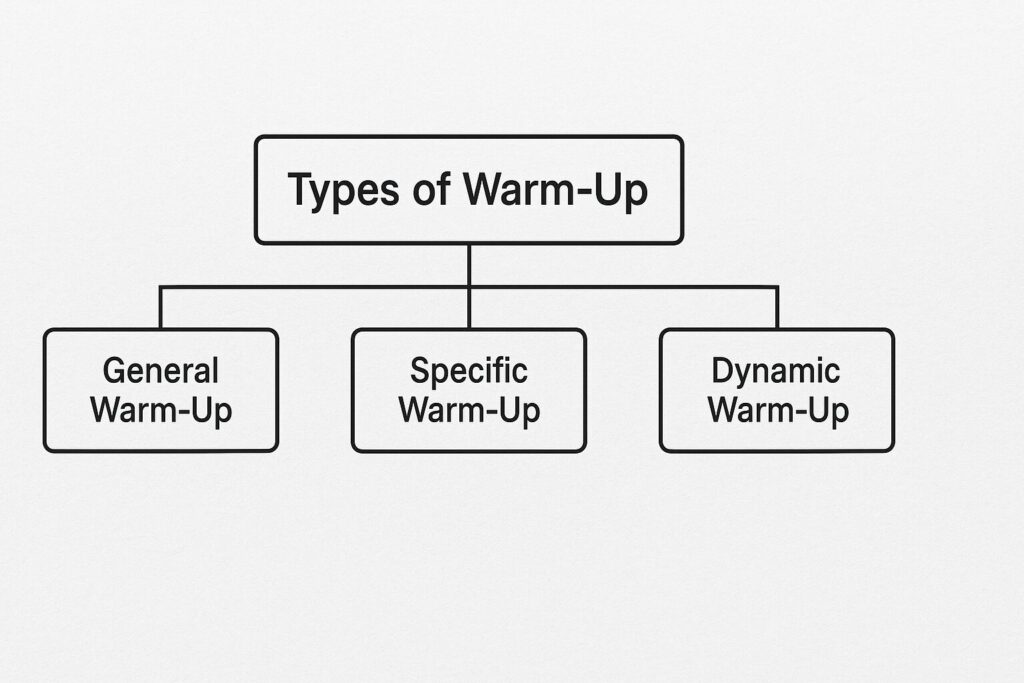
There isn’t just one correct way to warm up. Different goals and activities require different approaches. Broadly speaking, warm-ups can be categorized into general, specific, and dynamic types.
1. General Warm-Up
This involves low-intensity, whole-body movement that increases heart rate and body temperature — like light jogging, cycling, or jump rope. It’s the foundation for everything that follows.
2. Specific Warm-Up
Here you mimic the main activity you’re about to perform, but at reduced intensity. For example, before squatting, you might perform lighter squats or bodyweight versions. Before sprinting, do short accelerations or technique drills. This type directly activates the exact muscles and movement patterns you’ll use.
3. Dynamic Warm-Up
Dynamic exercises move the joints through their full range of motion while maintaining constant motion. Think of leg swings, arm circles, or walking lunges. Dynamic warm-ups are particularly effective for improving mobility and coordination without reducing power output — unlike static stretching done before training.
How to Do a Proper Warm-Up
A good warm-up doesn’t need to be long — usually 10 to 15 minutes is enough. The key is progression: start easy, and gradually increase the intensity until your heart rate, breathing, and muscle temperature rise noticeably.
Here’s a step-by-step guide:
- Start with General Movement (3–5 min)
Begin with light cardio — brisk walking, jogging, cycling, or jump rope — to elevate body temperature. - Add Dynamic Mobility (3–5 min)
Include joint rotations, leg swings, hip circles, and arm movements to increase range of motion. - Activate Key Muscles (2–3 min)
Perform activation drills for the muscles you’ll use most — glute bridges, planks, or banded walks are great examples. - Finish with Specific Preparation (2–5 min)
Do a few lighter sets or technical drills that simulate your main exercise. For instance, warm-up sets before heavy lifts or short bursts before sprints.
What NOT to Do During a Warm-Up
A warm-up is about preparation, not exhaustion. Here are common mistakes to avoid:
- Don’t Go Too Hard Too Soon
Starting with high intensity can cause fatigue before the actual workout begins. Gradual increase is the key. - Avoid Static Stretching Before Training
Long static holds can reduce muscle power and reaction time. Save them for post-workout recovery. - Don’t Skip Specific Movements
Jumping straight from cardio to heavy lifting without targeted preparation can increase injury risk. - Avoid Random, Unplanned Movements
Every warm-up should have purpose — random flailing or “just doing something” wastes time and does little for performance.
The Science Behind It
Warming up boosts enzymatic activity inside muscle cells, allowing for faster energy metabolism. It also enhances muscle fiber recruitment — meaning you can engage more fibers per contraction. Neurologically, it primes motor units for synchronization, improving strength and coordination.
In simpler terms: warming up makes you stronger, faster, and more efficient in every movement.
Psychological Readiness
Physical benefits aside, a warm-up also serves as a mental ritual. It signals to your brain that it’s time to focus, helps regulate breathing, and builds intention. Athletes who follow consistent warm-up routines report greater confidence and better concentration during competition.
Sport-Specific Examples
- Weightlifting: Start with bar-only squats or presses before loading plates. Include shoulder mobility drills.
- Running: Begin with brisk walking, then light jogging, followed by dynamic strides.
- Combat Sports: Include mobility for hips and shoulders, shadowboxing, and controlled technique drills.
- CrossFit or HIIT: Focus on joint prep, activation, and movement patterns that match the workout of the day.
The Optimal Warm-Up Duration
Ten to fifteen minutes is the sweet spot for most workouts. The goal is to feel warm — not tired, not drenched in sweat. If your heart rate is slightly elevated, breathing deeper, and muscles feel looser, you’re ready.
Key Takeaway
A warm-up isn’t optional — it’s performance insurance. It primes every system in your body for the work ahead, boosts output, prevents injuries, and enhances focus. Whether you’re lifting heavy, running long, or performing skill work, start smart: warm up first.
Because no matter how advanced your training becomes, skipping the basics always comes at a cost.
About the Author

Forge Your Mind. Build Your Biology.
Join the Forge Biology newsletter — where science meets strength.
Every week, you’ll get:
-
Evidence-based insights on training, performance, and recovery
-
Real analyses of supplements that work (and the ones that don’t)
-
Deep dives into hormones, nutrition, and human optimization
No fluff. No marketing hype. Just data-driven knowledge to build a stronger body — and a sharper mind.
Subscribe now and start mastering your biology.